


NOVACES’ economic analysis of labor impacts and tourism projections quantified several billion dollars in lost revenue and informed recovery plans.
Client: U.S. Department of Commerce, Economic Development Administration
In the aftermath of the devastating Lahaina wildfires in August 2023, a NOVACES team—supporting the Economic Development Administration’s Economic Recovery Support Function (ERSF)—identified a critical gap: insufficient data was available to inform a coordinated, evidence-based recovery strategy. Without robust analysis, recovery efforts risked fragmentation and limited impact. Led by Certified Economic Developers (CEcD), the NOVACES team conducted in-depth research and economic analysis to quantify billions of dollars in losses, providing local, state, and federal leaders with vital insights to guide recovery planning.
Challenges
The August 8, 2023, wildfires in Maui, Hawai‘i, rank among the deadliest in U.S. history—claiming at least 102 lives, leaving two people missing, and destroying approximately 2,200 structures. The town of Lahaina, once the royal capital of Hawai‘i, was consumed by flames in just 18 minutes. Under federal recovery efforts, the ERSF’s mission was to restore economic activity, build long-term resilience, and create opportunities for sustainable growth. Key recovery objectives included:
- Fostering transparent, community-driven engagement
- Supporting business restoration and resilience
- Advancing workforce development
- Promoting economic diversification
Solutions Delivered
Economic Impact Assessment
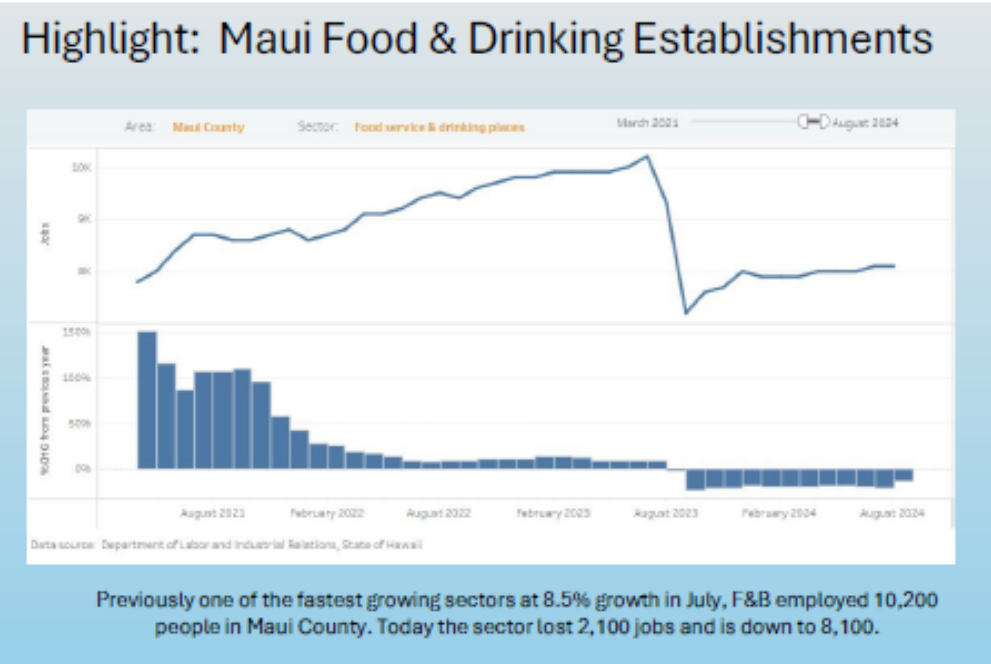
NOVACES conducted a comprehensive analysis of labor market disruptions and tourism revenue losses—estimated in the billions. A dynamic dashboard was developed and shared monthly with county, state, and federal leaders to monitor key indicators over time.
Revitalizing Tourism
With tourism accounting for roughly 70% of Maui’s economy, NOVACES partnered with the Maui Hotel & Lodging Association to explore challenges in workforce recovery and promote the island as a safe, desirable travel destination. Findings informed the County’s initiative on regenerative tourism in alignment with the Hawai‘i Tourism Authority.
Economic Recovery & Resilience Strategy
To support long-term economic diversification, NOVACES developed a concept paper detailing the barriers to business recovery and opportunities for investment attraction—laying the foundation for a more resilient local economy.
Business Restoration Support
In collaboration with the County’s Director of Economic Development, NOVACES contributed to the creation of a business recovery marketplace and pop-up district, including identifying funding sources and providers for temporary infrastructure.
Workforce Resilience & Reintegration
NOVACES conducted a workforce analysis highlighting outmigration trends and recruitment challenges in key industries. The report incorporated insights from a variety of stakeholders, including local unions, to inform reintegration strategies.
Building Resilience for Future Disruptions
Data gathered by NOVACES underscored the need for economic diversification to reduce reliance on tourism. Key findings were presented to policymakers to guide the development of a more balanced and resilient economic structure.
Key Takeaways
NOVACES provided critical research and insights that enabled state and local leaders to make data-driven recovery and development decisions. Our efforts helped:
Data-Driven Strategies Are Essential for Economic Recovery
NOVACES’ competitive analysis helped identify both obstacles and opportunities for attracting new industries, providing a roadmap for investment and economic diversification aligned with community and government goals.
Shared Data Creates Common Ground
In a landscape of differing priorities, clear and consistent data helped unify stakeholders around a shared understanding of the challenges—laying the groundwork for a collaborative, community-based recovery process.