


Process & Performance Improvement
In today’s market, organizations are scrambling to find ways to cut costs. But knowing which projects to select for the best and fastest returns presents a challenge to organizations whether at the beginning of a process & performance improvement initiative or needing to reenergize a current program.
Our Offerings
To address this need for speed and better return-on-investment, we designed a comprehensive deployment methodology called SystemCPI. Years in development and the result of proven applications, the approach establishes an enterprise’s process improvement needs up front, thus ensuring that resources are directed at projects with the biggest enterprise impact on competitiveness and financial performance.
SystemCPI breaks the barriers that impede traditional approaches and addresses a host of implementation issues such as strategic alignment, sustaining improvements, and the ability to quickly progress towards self-sufficiency.
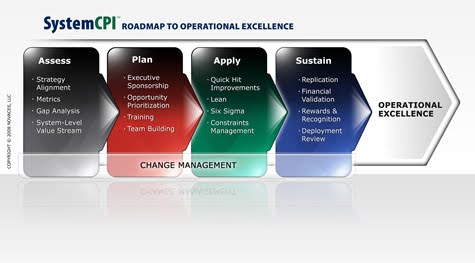
Deployment Planning
SystemCPI Deployment Roadmap
SystemCPI: Lean Six Sigma Implementation Planning
The integration of Lean and Six Sigma was the last real revolution in process improvement strategy. Now, with most of the low hanging fruit gone, leaders are challenged to implement breakthrough methods that produce increasingly better bottom line results.
SystemCPI, an integrated framework to deploy and manage a process improvement program, incorporates Constraints Management tools to understand the key leverage points of your organization. This roadmap simplifies management’s job by providing a systems perspective to focus improvements and break system constraints, especially given today’s economy and the scarce resources that are available.
We have refined and tested SystemCPI over years of application by expert CPI leaders to produce a holistic improvement methodology that eliminates the shortfalls of previous approaches:
- Scales to any size organization and aligns to existing business strategy.
- Shortens the traditional execution time from adoption to results.
- Optimizes the utilization of resources required to achieve the desired goals.
- Breaks system constraints and maximizes organizational efficiency.
- Sustains the gains and defines a path to self-sufficiency.
Whether you’re at the beginning of your journey to process excellence or needing to re-energize your current program, download the SystemCPI whitepaper to learn more about how to successfully integrate these methods for your organization.
SystemVSA Process Management
Enterprises that adopt programs such as Lean Six Sigma migrate from functional or product-based organizational structures to a process-centric architecture. To accomplish this, business leaders must focus on the system-level view using process management.
This standards-based architecture enables leaders to manage processes from end-to-end with clear accountability for business improvements. Moreover, process management provides a method to measure and benchmark processes.
Process experts from NOVACES can help to map an organization from the system-level and organize critical processes so that process owners are empowered to drive improvement activities. In this way, improvement efforts are aligned with enterprise strategy and linked with the critical needs of the customers of processes to achieve competitive and financial advantage.
To learn more about the benefits of process management and the related consulting services provided by NOVACES, contact us.
Project Identification
SystemCPI: Lean Six Sigma Implementation Planning
The integration of Lean and Six Sigma was the last real revolution in process improvement strategy. Now, with most of the low hanging fruit gone, leaders are challenged to implement breakthrough methods that produce increasingly better bottom line results.
SystemCPI, an integrated framework to deploy and manage a process improvement program, incorporates Constraints Management tools to understand the key leverage points of your organization. This roadmap simplifies management’s job by providing a systems perspective to focus improvements and break system constraints, especially given today’s economy and the scarce resources that are available.
We have refined and tested SystemCPI over years of application by expert CPI leaders to produce a holistic improvement methodology that eliminates the shortfalls of previous approaches:
- Scales to any size organization and aligns to existing business strategy.
- Shortens the traditional execution time from adoption to results.
- Optimizes the utilization of resources required to achieve the desired goals.
- Breaks system constraints and maximizes organizational efficiency.
- Sustains the gains and defines a path to self-sufficiency.
Whether you’re at the beginning of your journey to process excellence or needing to re-energize your current program, download the SystemCPI whitepaper to learn more about how to successfully integrate these methods for your organization.
Training
Executive / Champion
Lean Six Sigma Executive Training Workshop
Duration: 1 day
This workshop teaches senior business leaders the basics of Lean Six Sigma as a metric, methodology and management system. Participants learn the essential steps for implementing this proven process improvement methodology and link it to the organization’s business strategy. Through interactive workshops, essential actions are identified to successfully implement Lean Six Sigma in the enterprise. Further, stakeholder analysis is completed to ensure leadership commitment for the program.
Leaders will learn:
- Lean Six Sigma Evolution in Modern Business
- Enterprise View of Lean Six Sigma
- Implementation Approaches & Business Applications
- Essential Actions for Implementation Success
- Leadership Commitment Workshop
For more information on our Lean Six Sigma courses, contact us by clicking here
Black Belt
Lean Six Sigma Black Belt Training
Duration: 4 weeks (conducted over 4 months)
This course comprises mixed classroom training and project workshops to teach participants a broad set of change management skills and technical tools to solve an organization’s most costly problems. Each training week guides learners step-by-step through the Lean Six Sigma DMAIC (Define-Measure-Analyze-Improve-Control) project roadmap. Black Belt candidates arrive at training with a pre-selected project and apply the tools they learn to complete it and get real results. Training is tailored to the industry and the organization’s strategic needs. Download the course fact sheet.
For more information on our Lean Six Sigma courses, contact us.
Green Belt
Lean Six Sigma Green Belt Training
Duration: 2 weeks (conducted over 2 months)
This training comprises mixed classroom training and project workshops to teach participants a broad set of change management skills and technical tools to solve problems. Green Belt candidates arrive at training with a pre-selected project and apply the tools they learn to complete it and get real results. The first training week guides learners through the Define and Measure Phase of the Lean Six Sigma DMAIC (Define-Measure-Analyze-Improve-Control) project roadmap. Participants arrive at the second week with the Define and Measure phases of their projects completed and learn the remaining three phases, enabling Green Belt candidates to complete their first project within weeks after the training is over. Training is tailored to the industry and the organization’s strategic needs.
For more information on our Lean Six Sigma courses, contact us.
Constraint Management / Theory of Constraints
Constraints Management
Duration: 4 hours
This introductory training session covers the fundamentals of Constraints Management. Participants will learn how the basic principles such as 5 Focusing Steps and Logical Thinking processes are applied in various industries.
For more information about this course please call 1.877.577.6888 or click here to contact us by email.
Lean Expert
Lean Expert
Duration: 5 days
This course consists of classroom training, team workshops and simulations to learn how lean enterprise concepts can be applied to simplify processes, improve cycle time and increase throughput. Participants work in teams to improve processes in realistic simulations to gain hands-on experience with Value Stream Analysis and Rapid Improvement Workshops. The concept of process variation, statistics and basic quality tools also are introduced to form a foundation for understanding the Six Sigma methodology.
For more information on our Lean Six Sigma courses, contact us.
Facilitation
Value Stream Analysis / Process Mapping Events
Lean Workshops
Our Lean workshops attack waste, inefficiencies and defects enterprise-wide. However, these efforts don’t have to be overly complex. Our on-site facilitation can quickly produce measurable results.
Importantly, we are successful in helping to identify where to start and how to prioritize process improvement opportunities to help our clients get the improvement impact and desired results.
Value Stream Analysis / Process Mapping Facilitation
Typical Duration: 1 week of off-site preparation / 1 week on-site eventValue Stream Analysis (VSA) is a high impact, low cost way to quickly improve processes. Importantly, the focus is shifted from departmental functions to satisfying the customer by looking at the complete value stream. The goal is to include only the steps in a process that add value to the product or service being provided.
NOVACES facilitators guide participants through the methodology to create a future-state process incorporating lean concepts for enhanced speed and efficiency. Teams learn how to work together using this method to achieve the vision for a streamlined process.
When coupled with the Lean Expert course, VSA sessions facilitated by NOVACES provide the knowledge and hands-on experience necessary to develop a client’s internal capabilities.
Click here to download a Value Stream Analysis case study in which cycle time was reduced by 75%
Rapid Improvement Workshops
Rapid Improvement Workshop Facilitation
Typical Duration: 1 week offsite preparation / 1 week on-site eventOur experienced facilitators will conduct an on-site Rapid Improvement Workshop (RIW) by building a team of process stakeholders to quickly improve a work process. The first week is conducted off-site to prepare the logistics, data, and team. The Rapid Improvement Workshop is completed on-site, during which the facilitator will show the team how to implement lean concepts in the work area. At the conclusion of the workshop, a plan of action is developed ensuring that actions are completed and results are realized.
Project Mentoring
Mentoring Programs as a Lean Six Sigma Enabler
One key area frequently overlooked in process improvement deployments is the importance of developing experts who understand both the art and science of mentoring to grow real internal capabilities.
Lean Six Sigma has revolutionized the world of business, bringing about a new measure of success in customer satisfaction and quality. However, companies that have had successful deployments discover that their programs begin running out of steam if they are not able to continuously hone and align with the latest business priorities and objectives. So how can an enterprise revitalize its efforts to keep pace and continue to be a relevant and supportive force in driving the business?
There are several places to examine how a deployment evolves: alignment with strategic goals, project selection, infrastructure, selecting the right people to become involved and so forth. Yet one key area frequently overlooked is the importance of using practitioner mentoring programs as a means to re-energize a program and drive the kind of ongoing project accomplishments that support an enterprise’s needs.
Accelerate Performance and Maximize ROI
Partner with NOVACES to implement SystemCPI™ and unlock measurable improvements in efficiency, cost savings, and enterprise performance.