Posts By :

novaces

NOVACES Awarded Air Force Medical Services Contract for Continuous Process Improvement Support

NOVACES Awarded Air Force Medical Services Contract for Continuous Process Improvement Support 150 150 Novaces | Lean Six Sigma Training | Process Improvement | Healthcare | Government | Defense

Jul 8, 2022

NOVACES Awarded Air Force Medical Services Contract for Continuous Process Improvement Support

NOVACES is proud to announce its selection along with its teaming partner, ArcSource Group, Inc., to provide Continuous Process Improvement (CPI) support under their Air Force Medical Services Contract (AFMS). As part of this engagement, the NOVACES team will deliver expert analysis and consulting, training support, and project management services.


This effort is part of the Air Force’s ongoing CPI program—formerly known as Air Force Smart Operations for the 21st Century (AFSO21)—which aims to drive a culture of innovation, operational efficiency, and mission readiness across all levels of the service. By harnessing new technologies and the creativity of Airmen, the program seeks to enhance mission execution while reducing operational costs—ultimately maximizing value to the taxpayer.


NOVACES will provide its specialized expertise in Lean, Six Sigma, and Design for Six Sigma (DFSS) methodologies to help AFMS leaders and teams embed sustainable process improvement capabilities throughout their organizations. The company’s practitioners will collaborate with CPI managers and staff across headquarters, centers, and wings to facilitate problem-solving sessions, coach implementation of solutions, and guide strategic improvements across all mission and functional areas.

NOVACES Awarded Prime Contract to Advance Lean Six Sigma and Process Improvement Initiatives at Navy Medicine

NOVACES Awarded Prime Contract to Advance Lean Six Sigma and Process Improvement Initiatives at Navy Medicine 150 150 Novaces | Lean Six Sigma Training | Process Improvement | Healthcare | Government | Defense

Sep 17, 2021

NOVACES Awarded Prime Contract to Advance Lean Six Sigma and Process Improvement Initiatives at Navy Medicine

NOVACES was awarded a Prime Contract by Navy Medicine’s (NAVMED) Performance Improvement Office (PIO). Under this award, NOVACES will deliver Lean Six Sigma (LSS), process improvement, administrative, and knowledge management support across the Navy Medicine Enterprise.


The contract supports operations at the Bureau of Medicine and Surgery (BUMED), regional commands, and other NAVMED organizations. NOVACES will provide local performance improvement resources, project management expertise, and administrative program support to enhance mission effectiveness and operational efficiency.


The scope of the program focuses on sustaining and advancing NAVMED’s LSS program. LSS combines the benefits of both Lean manufacturing techniques and Six Sigma to help organizations streamline operations, increase value and reduce waste. A key aspect of this initiative is project management and support of the Belt Development Program, specifically to mentor the Regional Black Belts (RBB), Command Black Belts (BB), and Green Belts (GB) in the use of industry-leading methodologies.


NOVACES is proud to have supported Navy Medicine’s Lean Six Sigma and process improvement efforts since 2008, and this latest award reinforces its long-standing commitment to continuous improvement in federal healthcare operations.

Department of Commerce’s Economic Development Administration Awards NOVACES with IRWA for Disaster Recovery Services in Puerto Rico

Department of Commerce’s Economic Development Administration Awards NOVACES with IRWA for Disaster Recovery Services in Puerto Rico 150 150 Novaces | Lean Six Sigma Training | Process Improvement | Healthcare | Government | Defense

Aug 20, 2020

Department of Commerce’s Economic Development Administration Awards NOVACES with IRWA for Disaster Recovery Services in Puerto Rico

NOVACES has been awarded a task order under its Blanket Purchase Agreement with the U.S. Department of Commerce’s Economic Development Administration (DOC EDA). The award activates NOVACES to deliver critical economic recovery services in Puerto Rico, supporting the Island’s ongoing recovery efforts following Hurricanes Maria and Irma in 2017.

Distinct from our previous DOC EDA Disaster Recovery task orders for economic recovery work in Puerto Rico, this engagement is structured as an Interagency Reimbursable Work Agreement (IRWA) between DOC EDA and the Federal Emergency Management Agency (FEMA), marking an increased level of interagency collaboration for disaster recovery across the Territory and in the region.

NOVACES will provide National Disaster Recovery Framework implementation support at the Joint Recovery Office (JRO) in San Juan, Puerto Rico. As part of this effort, we will conduct Economic Recovery Support Function (RSF) meetings, facilitate industry development initiatives, and deliver strategic capacity-building events across the Island. These activities are designed to engage diverse communities and equip local stakeholders in driving sustainable economic revitalization.

NOVACES has contributed to innovative economic recovery initiatives on the Island since our first task order was awarded in September 2017. As recent disasters across the U.S. continue to reach unprecedented levels of scale and impact, NOVACES is delivering a more structured and proactive approach to preparedness, response, and long-term recovery—delivering strategies that accelerate recovery and strengthen long-term resilience and readiness for future events.

Maintaining Business Continuity in Crisis – COVID-19

Maintaining Business Continuity in Crisis – COVID-19 150 150 Novaces | Lean Six Sigma Training | Process Improvement | Healthcare | Government | Defense
Submitted By: Brian MacClaren

Author: Paul Dean, NOVACES (Washington, D.C.)

Amidst the uncertainty of the current environment, the currency of information expires within a few short weeks, sometimes merely within days.  Indeed, the global outlook in February 2020 is entirely alien in the context of what we now know two months later.  However volatile our predicament may seem though, two things are certain: the pandemic of COVID-19 will ultimately end, and another pandemic looms on the horizon.  While it is exceedingly difficult to consider returning to the status quo, it is imperative that leadership aligns business objectives with that inevitability in mind.  Whether the crisis subsides in six weeks or six months, the organizations that can maintain continuity in their operations will emerge leaps and bounds ahead of their peers when the dust settles.

A calamity of this scale is unprecedented in our lifetime, so it is of little wonder that organizations are channeling the entirety of their resources towards combating the issue.  In fact, the gravity of the situation almost necessitates this colossal response.  However, many institutions are failing to consider the trade-offs of this all-in approach.  The intent of this paper is to shed light on these concerns in the hope that leaders will evaluate the true opportunity costs at stake and calibrate a more measured response.  The ideal end state is to achieve impactful contributions at the current worldwide forefront while simultaneously accomplishing most business objectives that existed prior to the crisis.  There are numerous paths to attaining this end, but each response will require a certain measure of the following key tactics: reallocation of human capital, focused process improvement, and strategic emphasis.

Reallocation of Human Capital.  A catastrophic event has the potential to shake the foundation of an organization’s strategic vision, and talent management is typically the first casualty.  As Von Molke’s timeless insight goes, “no plan survives first contact”, and leaders’ first impulse in dire circumstances is to forgo previously assigned roles and responsibilities.  In doing so, they immediately redirect most of their assets to address the issue at hand.  Although this may be the best tactic for weathering the adverse effects of the predicament, it will not age well.  If management dedicates an overabundance of human capital to the principal problem, they will neglect to realize the gains from their routine business operations.  A rudimentary example will illustrate this further.

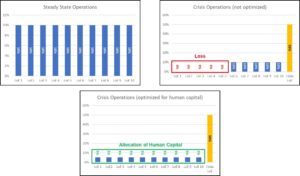
In a hypothetical scenario, an organization has ten lines of effort.  Each line of effort conveniently utilizes ten percent of the overall manpower.  Further, the program management office has rank ordered each of the groups by strategic importance from one to ten.  In the event of a disaster, senior management decides that they will re-purpose personnel from the bottom five lines of effort to their new crisis management response team.  While they will still reap the rewards of five of their original objectives and mitigate the crisis, they are absorbing an enormous opportunity cost by indefinitely forestalling the other five objectives.  An alternative and far more efficacious approach is to sub divide the workload of the degraded lines of effort among the team members of the remaining five groups.  Figure 1 captures the benefits of optimizing human capital:
maintaining-business-continuity-figure-1

Figure 1.

Although it seems untenable to suddenly modify the workload of a small portion of employees, properly assessing the available human capital will show that there are individuals who are up to the task.  To be clear, the untimely upheaval in company structure will still diminish business objectives, but having a dedicated team maintaining forward progress outside the scope of the crisis will ensure the continued delivery of value to the organization.  Notwithstanding, maintaining business continuity with severely constrained resources will require the innovative tools of focused process improvement.

Focused Process Improvement.  If rearrangement of the manpower inventory is the catalyst for achieving business continuity, then harnessing process improvement tools is the fuel that keeps the initiatives in motion.  Unfortunately, channeling resources to alleviate crisis magnifies the effects of the triple constraints on enduring efforts.  Inadequate resourcing, condensed timelines, and reduced scope all threaten to test the limits of the team, so innovative approaches are vital.  Leaders must empower their subordinates by deferring to their expertise and affording them the latitude to accomplish tasks via unconventional approaches.  With newfound influence, the team will be able to rapidly identify various inefficiencies and defects in the organization’s processes.  Often it takes extraordinary and challenging circumstances to identify issues that would never be addressed under the status quo.  Identifying problems is only half the battle though.  Failing to conduct analysis and provide a viable solution can simply exacerbate the issue.  Hence, focused process improvement is an invaluable asset that will help frame the problem and keep the team fixated on improvement.  An example of an all too common bureaucratic procedure will exemplify this.

Using the same theoretical company in the previous example, the business continuity team quickly realizes that there are significant procedural hurdles when moving projects through the project life cycle.  Mandatory phase gate meetings, progress reviews, and numerous stakeholder updates overburden the team’s capacity.  Furthermore, each of these engagements requires follow-up documentation that gets routed for signature approval through several departments.  The team decides to focus solely on this governance aspect of the lifecycle process and determines that they can reduce the number of touch points by 75 percent.  These measures alleviate the already constrained continuity team’s responsibilities and allow them to devote more of their time to advancing the timely completion of deliverables.

In unprecedented times, the amplification of constraints calls for both inventive allocation of talent and the application of process improvement to continue impacting the bottom line.  However, these tactics are not fruitful if the organization lacks the proper vision.

Strategic Emphasis.  The utility of creative solutions is meaningless if leaders do not support it.  Although the world has turned its attention exclusively towards the crisis, the onus is on management to keep delivering value while concurrently averting the fallout of the pandemic.  The shadow of disaster shrouds mundane operations from view, but a failure to sustain continuity will incur a hefty cost when normality returns.  The leaders who understand the criticality of these costs will divide their talent pool in a way that does not bring standard operations to a grinding halt.  They will vest their teams with the proper tools and message the strategic importance of bringing those tools to bear.  Ultimately, this top-level emphasis is a transparent way to show that leaders acknowledge the gravity of the current environment yet have the foresight to anticipate the future that lies ahead.

Although all eyes are now on the pandemic, there will come a time when they revert to steady state operations.  When that time comes, those who took the twofold approach towards maintaining business continuity and confronting COVID-19 will emerge in far greater standing.  Rather than spend months or even years picking up the pieces in the aftermath, the organizations that practiced resiliency and portrayed adaptability will be paragons for future success when the next catastrophe strikes.

NOVACES Supports Lusk With Economic Development Expertise After Devastating Flood

NOVACES Supports Lusk With Economic Development Expertise After Devastating Flood 150 150 Novaces | Lean Six Sigma Training | Process Improvement | Healthcare | Government | Defense

Submitted By: Brian MacClaren

NOVACES is supporting the Economic Development Administration’s field operations staff in Lusk, Wyoming after floods devastated a majority of the town’s homes and businesses. The flooding was a result of severe thunderstorms on June 3, 2015 which caused an overpass to collapse and divert fast-moving flood waters into the town’s central business district.

NOVACES is contracted to provide disaster recovery and economic development advisory services which includes quantitative and qualitative data analysis, community engagement to organize federal support of recovery activities, and recommendations for technical assistance options to mitigate issues with the recovery.

NOVACES Supports Lusk, Wyoming with Economic Development Expertise after Devastating Flood

NOVACES Supports Lusk, Wyoming with Economic Development Expertise after Devastating Flood 150 150 Novaces | Lean Six Sigma Training | Process Improvement | Healthcare | Government | Defense
Nov 4, 2015

NOVACES Supports Lusk, Wyoming with Economic Development Expertise after Devastating Flood

NOVACES is supporting the Economic Development Administration’s field operations staff in Lusk, Wyoming, after floods devastated a majority of the town’s homes and businesses. The flooding was a result of severe thunderstorms on June 3, 2015, which caused an overpass to collapse and divert fast-moving flood waters into the town’s central business district.

NOVACES is contracted to provide disaster recovery and economic development advisory services, including quantitative and qualitative data analysis, community engagement to organize federal support of recovery activities, and recommendations for technical assistance options to mitigate issues with the recovery.

NOVACES Supports Lusk With Economic Development Expertise After Devastating Flood

NOVACES Supports Lusk With Economic Development Expertise After Devastating Flood 2560 996 Novaces | Lean Six Sigma Training | Process Improvement | Healthcare | Government | Defense
Submitted By: Brian MacClaren

NOVACES is supporting the Economic Development Administration’s field operations staff in Lusk, Wyoming after floods devastated a majority of the town’s homes and businesses. The flooding was a result of severe thunderstorms on June 3, 2015 which caused an overpass to collapse and divert fast-moving flood waters into the town’s central business district.

NOVACES is contracted to provide disaster recovery and economic development advisory services which includes quantitative and qualitative data analysis, community engagement to organize federal support of recovery activities, and recommendations for technical assistance options to mitigate issues with the recovery.

Improving Project Portfolio Performance with Buffers

Improving Project Portfolio Performance with Buffers 150 150 Novaces | Lean Six Sigma Training | Process Improvement | Healthcare | Government | Defense

Click the link below to view the TOCICO 2015 presentation “Improving Project Portfolio Performance with Buffer-Type Flexibility and Task-level DBR”

TOCICO PPM Buffer-type Flexibility + Task-level DBR

Utah’s SUCCESS Framework on the Inside, for Success on the Outside

Utah’s SUCCESS Framework on the Inside, for Success on the Outside 150 150 Novaces | Lean Six Sigma Training | Process Improvement | Healthcare | Government | Defense
Submitted By: Brian MacClaren

Click the link below to view the “Working with the SUCCESS Framework on the Inside, for Success on the Outside” presentation at TOCICO 2015.

Link to presentation slides:

TOCICO_UCI 9-2-2015

Link to video:

Working with SUCCESS Framework

See a video clip of our presentation at TOCICO

See a video clip of our presentation at TOCICO 1512 616 Novaces | Lean Six Sigma Training | Process Improvement | Healthcare | Government | Defense
Submitted By: Brian MacClaren

NOVACES and its collaborators are excited to have been selected for several presentations at 2015 TOCICO in Cape Town. Below is information about one of our presentations or click here to watch a promo video.

Improving Project Portfolio Performance with Buffer-Type Flexibility and Task-level DBR
Bahadir Inozu, Ph.D., NOVACES, LLC
Mike Hannan, Fortezza Consulting
Hilbert Robinson, Delta Airlines

This presentation focuses on two emerging techniques to improve project portfolio performance within a CCPM framework:

1)   The addition of scope buffers and budget buffers to augment CCPM’s traditional emphasis on schedule buffers, boosting portfolio reliability while allowing harmonious integration of scope-buffered project methods (such as Agile) into CCPM.

2)   The addition of DBR, Lean, and Agile methods to augment CCPM’s traditional emphasis on single tasking, boosting the flow of task completions to improve portfolio throughput.

While these two techniques have demonstrated performance improvements in software-development project portfolios, we will also present how they can also be applied in other project-centric domains.

Novaces | Lean Six Sigma Training | Process Improvement | Healthcare | Government | Defense