Posts By :

novaces

NOVACES Presents on Critical Chain for Facilities Management at the 2014 Project Management Symposium

NOVACES Presents on Critical Chain for Facilities Management at the 2014 Project Management Symposium 150 150 Novaces | Lean Six Sigma Training | Process Improvement | Healthcare | Government | Defense

Jun 18, 2014

NOVACES Presents on Critical Chain for Facilities Management at the 2014 Project Management Symposium

NOVACES presented on Wednesday, June 11 at the 2014 Project Management Symposium, sponsored by The Project Management Institute’s Silver Spring Chapter. Their presentation, Taming the Chaos in the Annual Capital Budgeting Process with Multi-Project Critical Chain, was presented by Hilbert Robinson and covered the use of project portfolio management and critical chain concepts to improve the management of maintenance and capital improvement projects at a non-profit medical center.

This presentation is based on a case study with St. Alexius Medical Center in Bismarck, North Dakota. NOVACES worked with St. Alexius to implement BeingManagement, a project portfolio management solution that enables an organization to increase productivity, improve on-time completion reliability, and produce more accurate forecasting.

St. Alexius Medical Center is a 306-bed, full-service, acute care medical center offering a full line of inpatient and outpatient medical services, including primary and specialty physician clinics; home health and hospice services; durable medical equipment services and a fitness and human performance center. Since the hospital’s founding in 1885, St. Alexius Medical Center has been serving residents of central and western North Dakota, northern South Dakota and eastern Montana.

The result of this implementation has allowed St. Alexius management a much improved line-of-sight on project delays, and the ability to better prioritize which corrective actions need to be taken to protect cost and schedule requirements.  When asked about his impressions of the outcome of the project, Mr. Robinson responded, “An important result is improved coordination with the construction trades which has produced for St. Alexius significantly more value and predictability from its investment in the capital projects – the chaos has truly been tamed.”

Those interested in receiving a copy of the presentation can send a contact request at www.novaces.com/contact.

NOVACES Scheduled to Present Jointly with Three Clients at the 2014 TOCICO Conference

NOVACES Scheduled to Present Jointly with Three Clients at the 2014 TOCICO Conference 150 150 Novaces | Lean Six Sigma Training | Process Improvement | Healthcare | Government | Defense

Jun 6, 2014

NOVACES Scheduled to Present Jointly with Three Clients at the 2014 TOCICO Conference

NOVACES will make three joint presentations at the 2014 Theory of Constraints International Certification Organization (TOCICO) Conference with the State of Utah, St. Alexius Medical Center and Turkish Airlines Technic.


NOVACES will make the presentaionts at the Theory of Constraints International Certification Organization Conference (TOCICO) conference June 8-11. The presentations are reports of projects conducted at client organizations, which include applications of Theory of Constraints tools including Critical Chain Project Management, Dynamic Replenishment, and Thinking Processes.


TOCICO is a global not-for-profit certifcation organization that unites people who share a passion for win-win holistic thinking and share a vision that this will become the main way to manage organizations. The Theory of Constraints (TOC) provides a set of holistic processes and rules, all based on a systems approach that exploits the inherent simplicity within complex systems through focusing on a few “leverage points” as a way to synchronize the parts to achieve ongoing improvement in the performance of the system as a whole.


The 2014 TOCICO Conference takes place at the Bolger Center in Washington, D.C from June 8-11. NOVACES presentations include the following:


Theory to Practice in a Social Service Environment; presented by Bahadir Inozu of NOVACES LLC and Greg Gardner, Director of Operational Excellence at Utah Governor’s Office of Management and Budget

Taming the Chaos in the Annual Capital Budgeting Process with Multi-Project Critical Chain; presented by Hilbert Robinson of NOVACES LLC and St Alexius Medical Center

Implementing Dynamic Replenishment for Higher Availability with Less Inventory: Results from Turkish Airlines Technic; presented by Bahadir Inozu of NOVACES LLC and Turkish Airlines Technic.


When asked about the role NOVACES is playing at the conference, co-founder Bahadir Inozu, Ph.D. said, “the NOVACES team is excited about the opportunity to present the applications of Focused Performance Improvement in Government, Aviation MRO and Hospital Construction & Maintenance industries at the TOCICO conference. The principles of TOC – Theory of Constraints – have been applied to find the leverage points and then Lean and Six Sigma were utilized to very quickly produce the best and most consistent results.”

In the Dynamic Replenishment presenation, Dr. Inozu will show the approach that enabled Turkish Airlines Technic to reach 98% service levels with about 40% less inventory.

Dr. Inozu added, “We are especially delighted to work with the Utah State Government’s Success Program to boost the quality and efficiency of government services with the goal of delivering ever-increasing value per dollar to the citizens of the state of Utah.”


More information about the conference can be found at http://www.tocico.org/?page=2014_speakers.

NOVACES Awarded a Task Order Under Government-Wide Continuous Process Improvement to Support the Office of the Chief Management Officer

NOVACES Awarded a Task Order Under Government-Wide Continuous Process Improvement to Support the Office of the Chief Management Officer 150 150 Novaces | Lean Six Sigma Training | Process Improvement | Healthcare | Government | Defense

Submitted By: Brian MacClaren

NOVACES is teamed with Calibre to provide technical support to the Office of the Deputy Chief Management Officer.

NOVACES announced today that they were competitively awarded a Task Order (TO) under their Blanket Purchase Agreement (BPA) for Government-Wide Continuous Process Improvement Services. NOVACES is teamed with Calibre, who is the prime contractor for the BPA.

Under this task order, NOVACES and its team members will provide functional and technical support to the Office of the Deputy Chief Management Officer (ODCMO) and other Department of Defense (DoD) agencies. Specifically, this functional and technical support will be to use Continuous Process Improvement and Lean Six Sigma techniques to significantly reduce process inefficiencies, improve transaction times, mitigate costs, and increase return on investment within DoD operations.

NOVACES, who has supported government performance improvement initiatives and business transformations for nearly ten years, promotes the use of a suite of best-practice management tools to improve government processes. “We cannot expect government to become more efficient without providing them the same advances in management strategy and performance improvement that the private sector has employed with great success,” said Radovic. “There is a constant learning curve in this area that the government must keep up with to meet the expectations of our taxpayers.”

More information is available at www.novaces.com/gsa-pm-cpi-bpa.

NOVACES Successfully Re-competes for Navy Medicine Contract in Support of the Continuous Process Improvement and Lean Six Sigma Program

NOVACES Successfully Re-competes for Navy Medicine Contract in Support of the Continuous Process Improvement and Lean Six Sigma Program 150 150 Novaces | Lean Six Sigma Training | Process Improvement | Healthcare | Government | Defense
Submitted By: Brian MacClaren
Categories: Headlines

Lean Six Sigma Master Black Belt and Black Belt consulting and training services to be provided for Navy Medicine in this three-year BPA contract.

NOVACES announced today that it has been awarded a firm fixed price contract by Navy Medicine to support the deployment of the Continuous Process Improvement (CPI) and Lean Six Sigma (LSS) program. The goal of the CPI/LSS Program is to enhance Navy Medicine’s business processes which will in turn result in improved patient healthcare. This contract award represents a continuation of a previous five-year contract for CPI/LSS services with Navy Medicine dating back to 2007.

Under this contract, NOVACES will provide Master Black Belt (MBB) and Black Belt (BB) training classes; mentoring Navy Medicine BB and MBB candidates and their projects; continuously assess program maturity and program change management planning; and, develop with Navy Medicine leadership a glide path to achieve higher level of program maturity. NOVACES will provide these critical services across the country, but primarily in Portsmouth, VA; San Diego, CA; Jacksonville, FL; and the Washington DC area.

“NOVACES is proud to be tasked to continue providing important process improvement consulting and training services to Navy Medicine. Our successful bid for this re-compete is a testament to the excellent work our team has done to get results by working collaboratively with Navy Medicine,” said company President, Ivan Radovic. Navy Medicine is a global healthcare network of 63,000 Navy medical personnel around the world who provide high quality health care to more than one million eligible beneficiaries. Navy Medicine personnel deploy with Sailors and Marines worldwide, providing critical mission support aboard ship, in the air, under the sea and on the battlefield.

NOVACES Awarded a Task Order Under Government-Wide Continuous Process Improvement to Support the Office of the Chief Management Officer

NOVACES Awarded a Task Order Under Government-Wide Continuous Process Improvement to Support the Office of the Chief Management Officer 150 150 Novaces | Lean Six Sigma Training | Process Improvement | Healthcare | Government | Defense

May 28, 2014

NOVACES Awarded a Task Order Under Government-Wide Continuous Process Improvement to Support the Office of the Chief Management Officer

NOVACES is teamed with Calibre to provide technical support to the Office of the Deputy Chief Management Officer.


NOVACES, a leading management consulting firm for public sector process improvement services, announced today that they were competitively awarded a Task Order (TO) under their Blanket Purchase Agreement (BPA) for Government-Wide Continuous Process Improvement Services. NOVACES is teamed with Calibre, who is the prime contractor for the BPA.


Under this task order, NOVACES and its team members will provide functional and technical support to the Office of the Deputy Chief Management Officer (ODCMO) and other Department of Defense (DoD) agencies. Specifically, this functional and technical support will be to use Continuous Process Improvement and Lean Six Sigma techniques to significantly reduce process inefficiencies, improve transaction times, mitigate costs, and increase return on investment within DoD operations.


NOVACES, who has supported government performance improvement initiatives and business transformations for nearly ten years, promotes the use of a suite of best-practice management tools to improve government processes. “We cannot expect government to become more efficient without providing them the same advances in management strategy and performance improvement that the private sector has employed with great success,” said Radovic. “There is a constant learning curve in this area that the government must keep up with to meet the expectations of our taxpayers.”


More information is available at www.novaces.com/gsa-pm-cpi-bpa.

NOVACES Successfully Re-competes for Navy Medicine Contract in Support of the Continuous Process Improvement and Lean Six Sigma Program

NOVACES Successfully Re-competes for Navy Medicine Contract in Support of the Continuous Process Improvement and Lean Six Sigma Program 150 150 Novaces | Lean Six Sigma Training | Process Improvement | Healthcare | Government | Defense

May 5, 2014

NOVACES Successfully Re-competes for Navy Medicine Contract in Support of the Continuous Process Improvement and Lean Six Sigma Program

Lean Six Sigma Master Black Belt and Black Belt consulting and training services to be provided for Navy Medicine in this three-year BPA contract.

NOVACES, a leading management consulting firm for performance improvement and continuous process improvement in the public sector, announced that it has been awarded a firm fixed price contract by Navy Medicine to support the deployment of the Continuous Process Improvement (CPI) and Lean Six Sigma (LSS) program. The goal of the CPI/LSS Program is to enhance Navy Medicine’s business processes which will in turn result in improved patient healthcare. This contract award represents a continuation of a previous five-year contract for CPI/LSS services with Navy Medicine dating back to 2007.


Under this contract, NOVACES will provide Master Black Belt (MBB) and Black Belt (BB) training classes; mentoring Navy Medicine BB and MBB candidates and their projects; continuously assess program maturity and program change management planning; and, develop with Navy Medicine leadership a glide path to achieve higher level of program maturity. NOVACES will provide these critical services across the country, but primarily in Portsmouth, VA; San Diego, CA; Jacksonville, FL; and the Washington DC area.


“NOVACES is proud to be tasked to continue providing important process improvement consulting and training services to Navy Medicine. Our successful bid for this re-compete is a testament to the excellent work our team has done to get results by working collaboratively with Navy Medicine,” said company President, Ivan Radovic. Navy Medicine is a global healthcare network of 63,000 Navy medical personnel around the world who provide high quality health care to more than one million eligible beneficiaries. Navy Medicine personnel deploy with Sailors and Marines worldwide, providing critical mission support aboard ship, in the air, under the sea and on the battlefield.

Using Current Reality Tree to Reduce Billing Errors for a Healthcare Client

Using Current Reality Tree to Reduce Billing Errors for a Healthcare Client 150 150 Novaces | Lean Six Sigma Training | Process Improvement | Healthcare | Government | Defense
Submitted By: Bob Sproull

In my last posting I told you I would take a look at some other performance metrics and see how they impact our improvement efforts. I’m going to delay that posting because I want to share an experience I had with one of my healthcare client’s teams. Although I won’t go into the details of the experience, I will tell you that they had proposed a change in the way a specific process is being run.

It has been said many times that the natural tendency of people is to resist change and in many ways I believe this premise. Assuming this resistance is real, why is it that people resist change? If you ask most people this question, you’ll probably get a response like, “it’s outside the comfort zone of the people being asked to change.” I know from my experiences that this is one of the most often heard responses to this question. There is an almost art to get people to change, but I’m here to tell you that it doesn’t have to be as difficult as some people make it.

When confronted with an opportunity to implement an improvement, many times we take the easy way out when we face this resistance by developing a compromise. A compromise is letting go of part of what we want and giving more of what the “changers” want. If we haven’t learned but one thing from the late Eli Goldratt it is that we should never compromise! A compromise is essentially a win-lose scenario when in fact we should only want to come away with a win-win one.

This team I mentioned earlier had a great idea about how to reduce the financial impact of missed billings. They had studied lost billings due to immunizations, but quickly realized that their solution would apply to other areas such as various medical tests and especially the more expensive tests like EKG’s, Point of Care Testing, etc.. In fact the amount of money lost due to immunization billing errors paled in comparison to these other tests.

So knowing that we have an excellent solution, the question becomes how do we present it without a compromise? From experience I know that as long as we think that the only way to handle a conflict is by compromising, such as trying to change a process, we won’t be successful in making the change. What needs to happen is that we must surface the assumptions on why we believe there will be resistance to the process change we are going to propose. And if we never think about the underlying assumptions and know how to remove at least one of them, we’ll never find the way to eliminate the conflict and “sell” our breakthrough solution. In fact, we’ll just simply lower our expectations and continue with business as usual.

The first and most profound obstacle to change is that people believe that reality is complex and sophisticated. And because we believe this, we have a tendency to believe that complex problems require complicated solutions. Goldratt introduced us to the concept of Inherent Simplicity which clearly states that complex problems require simple solutions. In other words, the more complicated the situation seems to be, the simpler the solution must be.

Earlier I mentioned that we need to develop a win-win solution, so how do we do this? The first place to start is by constructing a solution by seeking the other party’s win, but not the win that is in conflict. If we want our win to be bigger, we have to ensure that the other sides win will be bigger. In other words, we must demonstrate how by applying our solution, the side we are asking to change must see immediately that there is a win in the solution for them.

A good solution deals with the core conflict in that it changes an underlying assumption and therefore significantly changes the situation for the better. When you present your solution effectively, you immediately face a reality that is very different from the reality you’re currently in. We must first transfer ourselves into the future to realize the situation that will exist after the solution is implemented and then communicate that reality effectively. So back to our GB project.

The figure below in a simplified current reality tree that summarizes the most prominent Undesirable Effects (UDE’s) encountered by the team. In order to solve the billing error problem, the team had to identify a core problem that, if eliminated, would reduce the impact of many of these UDE’s.

The team concluded that by the MD’s not entering their immunization orders and instead gave verbal orders that the Medical Assistants (MA’s) made errors due to trying to translate what the MD had said. And if there were translation errors, then the charges would be incorrect. And when the front desk scanned the incorrect documents to the billing company, then the revenue from billing would be missing. The team then concluded that if the MD’s would simply enter their own orders (bottom entry on simplified CRT), then most of the UDE’s would disappear. The other problem stemmed from the problem that the billing documents were sometimes unreadable, so the team recommended that the billing document be redesigned to correct this problem.

So how could this simple solution (i.e. MD’s entering their own orders into the database) be a win-win. Quite simply, because of this simple change, there were other forms of paperwork that the MD would no longer have to fill out as they would now be completed by the MA’s. The result was, the MD could now see more patients. The MA’s liked this solution because they would know exactly what the MD’s orders were and they could prepare the immunizations, paperwork, etc. while the MD was still seeing the patient. The patients would like this, because their wait time would be reduced significantly. Just as soon as the MD opened the exam room door, the MA, having all that was needed to give the immunization, would simply walk in and administer the vaccine and the patient would leave. The organization would win by significantly reducing the lost revenue. So the team created a win-win-win solution that will be very simple to sell.

– Bob Sproull

Bob Sproull is the author of Epiphanized: Integrating Theory of Constraints, Lean and Six Sigma. The book is a business novel and is an attention-grabbing and fast-paced story of the transformation of Barton Enterprises, a manufacturer of fuel tanks for the aviation and defense industry. To learn more about the book, click here >>

NOVACES Enters Agreement to Become Exclusive North American Reseller of BeingManagement Software

NOVACES Enters Agreement to Become Exclusive North American Reseller of BeingManagement Software 150 150 Novaces | Lean Six Sigma Training | Process Improvement | Healthcare | Government | Defense

Oct 28, 2013

NOVACES Enters Agreement to Become Exclusive North American Reseller of BeingManagement Software

Being Co., Ltd. expands its global sales initiative of BeingManagement3 (BM3), a best-selling project management software in Japan, by forming this alliance with NOVACES for the North America territory.

NOVACES, a Louisiana-based management consulting firm, has entered into an agreement with Being Co., Ltd., to become the exclusive North American reseller of BeingManagement3 (BM3), an enterprise project portfolio management software designed to leverage the Critical Chain methodology.


NOVACES currently uses BeingManagement3 as a platform for its project management consulting business and has already implemented it with clients in the healthcare and manufacturing industries. This new relationship further strengthens the firm’s position to introduce the project portfolio management software to clients who require the business benefits of better schedule performance, increased capacity, and a more reliable system for planning and prioritization.


Being Co., headquartered in Tsu City, Japan, is a publicly traded software development company (JASDAQ: 4734). Being Co. has developed several highly successful software programs since its establishment in 1984, including its flagship civil construction estimating software called Gaia. Global sales of BM3 project management software has been steadily increasing since its launch in 2006 and is now being offered through a reseller network in Europe, India and North America.


BeingManagement3 project portfolio management software now holds the largest market share in Japan behind Microsoft Project according to the 2010 Fuji Chimera Research Institute study. In addition to a strong financial backing by its developer, Being Co. also has published implementation case histories with clients such as Omron, Mazda, and Ricoh. With more successful implementations in industries such as automotive manufacturing, software development, construction management, shipbuilding, engineer-to-order, and fleet maintenance, BeingManagement3 is well-positioned to serve the North American market.


As part of the alliance with Being Co., NOVACES will be responsible for performing marketing and sales activities in the North American territory, including development of a channel partner program and a global brand presence on the web and major social media outlets. More information about BeingManagement3 is available at www.novaces.com/beingmanagement and www.beingworldwide.com.

CEO Bahadir Inozu to speak at International Public Sector Effectiveness Conference 2013

CEO Bahadir Inozu to speak at International Public Sector Effectiveness Conference 2013 150 150 Novaces | Lean Six Sigma Training | Process Improvement | Healthcare | Government | Defense
Submitted By: Brian MacClaren

CEO Bahadir Inozu will be a featured speaker at this year’s International Public Sector Effectiveness Conference. It will be held on October 24-25 in Vilnius, Lithuania. Links to the topic and related workshop are below!

Presentation: How to Achieve Superior Performance Improvement by Integrating Constraints Management with Lean and Six Sigma: Examples from Government, Public Services and Healthcare

Workshop: How to Focus and Accelerate Performance Improvement: An Integrated Approach

Why Efficiency Metrics Mislead Us

Why Efficiency Metrics Mislead Us 150 150 Novaces | Lean Six Sigma Training | Process Improvement | Healthcare | Government | Defense
Submitted By: Bob Sproull

In the next few postings I want to talk about some of the basics of Continuous Improvement (CI). Not the tools of CI, but rather more of a strategic viewpoint. In other words, some of the principles and guidelines I use in my work which has provided me with a strategy that I can honestly say has never failed to deliver excellent results. But in order for everyone to clearly understand my approach, I need to back up and review some of the basic principles.

Let’s start this discussion with the end product… performance metrics. Why start with the end in mind you may be thinking? In my way of thinking, the key purpose of performance metrics is that they drive behaviors within an organization. For example, if operator efficiency is one of your metrics, what behaviors does it drive? The math used to calculate efficiency is that you have a standard time to complete a task or process step. If you complete this task in exactly the same time that the work standard says it should take, then your efficiency is 100%. On the surface, that seems like something that we all want, but let’s look at this more closely.

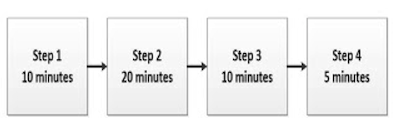
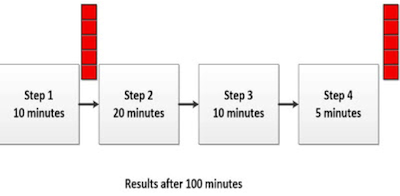
The figure above is a simple four-step process used to manufacture a product. Using the definition of efficiency, in order for Step 1 to achieve and sustain 100% efficiency, it would have to produce one product every ten minutes. Simple….right? But, in reality, what would happen after 100 minutes to this process if Step 1 continued producing one part every 10 minutes?

If Step 1 produced one part every 10 minutes and Step 2 could only process 1 part every 20 minutes, then Step 2 would only process 5 of the parts in 100 minutes. Step 3 would process all 5 of these parts as would Step 4. In other words, there would be 5 parts sitting directly in front of Step 2 waiting to be processed. This isn’t exactly what the results would look like, but for demonstration purposes, it will suffice. The point is, if Step 1 continued producing at its maximum capacity, the inventory would continue to build up in front of Step 2. Steps 1 and 2 would be operating at 100% efficiency, but what about Steps 3 and 4? Would it be possible for these two steps to reach 100% efficiency?

The problem with using efficiency as a performance metric is that it is controlled by the step with the least amount of capacity… the system constraint. The total system efficiency will always be less than 100 % simply because of the existence of the system constraint. The system efficiency for our process would be 100 % (Step 1) plus 100 % (Step 2), plus 50 % for Step 3, plus 25 % for Step 4 divided by 4 or 68.75 %. In fact, the only place where efficiency makes any sense at all is in the system constraint which in our process is Step 2.

The origins of operator efficiency lies in traditional cost accounting where the belief exists that everyone should be busy 100 % of the time. In our process it is clear that the operator in Step 3 would only be busy half of the time while the operator in Step 4 would only be busy one quarter of the time! The Cost Accountants would never stand for this and would be looking for manpower reductions!

So if operator efficiency isn’t a good performance metric (except in the constraint), then what is? In other words, how should we measure the performance of our 4-step process? In my next posting we’ll try to answer this question.

Bob Sproull

Bob Sproull is the author of Epiphanized: Integrating Theory of Constraints, Lean and Six Sigma. The book is a business novel and is an attention-grabbing and fast-paced story of the transformation of Barton Enterprises, a manufacturer of fuel tanks for the aviation and defense industry. To learn more about the book, click here >>

Novaces | Lean Six Sigma Training | Process Improvement | Healthcare | Government | Defense