Posts By :

novaces

NOVACES Awarded Blanket Purchase Agreement by General Services Administration for Government-Wide Continuous Process Improvement

NOVACES Awarded Blanket Purchase Agreement by General Services Administration for Government-Wide Continuous Process Improvement 150 150 Novaces | Lean Six Sigma Training | Process Improvement | Healthcare | Government | Defense

Sep 18, 2013

NOVACES Awarded Blanket Purchase Agreement by General Services Administration for Government-Wide Continuous Process Improvement

NOVACES, a leading management consulting firm that provides performance improvement and project management services to the public sector, announced today that they were competitively awarded a Blanket Purchase Agreement (BPA) for Government-Wide Continuous Process Improvement Services. NOVACES is teamed with Calibre, who is the prime contractor for the BPA.


Under the BPA, NOVACES and its team members will be able to support any organization within the Federal Government with Strategic Planning, Program Evaluation, Process and Performance Improvement, Communications and Change Management, and Training Services.


“This vehicle enables our government customers access to these critical services during this period where high performance and efficiency are paramount to the success of their missions and budget reduction initiatives,” said NOVACES president Ivan Radovic.


NOVACES, who has supported government performance improvement initiatives and business transformations for nearly ten years, promotes the use of a suite of best-practice management tools to improve government processes. “We cannot expect government to become more efficient without providing them the same advances in management strategy and performance improvement that the private sector has employed with great success,” said Radovic. “There is a constant learning curve in this area that the government must keep up with to meet the expectations of our taxpayers.”


The BPA will provide increased information sharing across government related to best practices in performance management and continuous process improvement. In addition, the acquisition process has been streamlined to enable the government easy access to resources and tools. More information is available at www.novaces.com/gsa-pm-cpi-bpa.

Throughput Accounting at Pittsburgh International

Throughput Accounting at Pittsburgh International 150 150 Novaces | Lean Six Sigma Training | Process Improvement | Healthcare | Government | Defense
Submitted By: Bob Sproull

The other day I was having a conversation at the Pittsburgh airport with a man that was carrying a copy of my book Epiphanized. He had so many questions for me and I was worried that I would miss my flight back to Georgia. I must admit that most of the questions were quite good and my answers settled a lot of issues in his mind. I thought in this posting that I would share one of the questions he had and how I answered it.

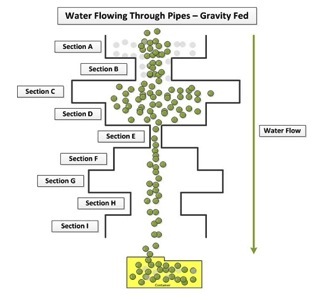
The first question he asked me had to do with Throughput Accounting. You see he was an accountant and didn’t understand why we needed a different accounting system when we had traditional Cost Accounting available. I just smiled and thought to myself, where should I start. I followed his question with a question of my own. I asked him if he thought manpower efficiency was a good metric and he immediately replied, “Yes, of course I do!” I asked him why he thought it was a good metric and, even though he had read our book, he told me that it was a great way to check on manpower requirements. He further said that if efficiency was low, then the workers weren’t doing their job. I then took out a piece of paper and drew my famous piping diagram.

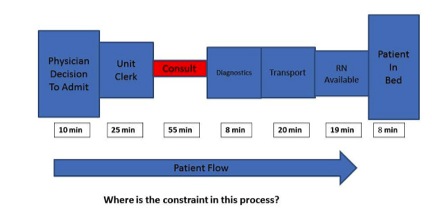
I asked him my usual question, “If you wanted to increase the amount of water flowing through these pipes, what would you have to do? He responded by saying, “That’s simple, you would have to increase the diameter of Section E.” I asked him why not just open up Section G’s diameter? He told me that would be stupid since no additional water would flow. So I then drew a simple Emergency Department process diagram and asked him the same question about what he would have to do to increase the number of patients passing through this process.

After giving it some thought, he said that the time for consult (55 minutes) would have to be decreased. I said, “You mean like the diameter having to be increased in the piping diagram?” He said yes. He then asked me what all this had to do with efficiencies? I asked him if he thought it would be a good idea to drive this ED process’s efficiency higher and he told me it would be a great idea. I then asked him how he would do this and his simple reply was, “Have everyone run their part of the process as fast as they could.” I then asked him what would happen if he ran the first two steps in this process as fast as they could? He thought about it for a bit and simply said, “I get it!” “If you run these steps as fast as you can, you’ll just stack up people waiting to consult with the physician.” We then talked about the steps after Consult and his conclusion was that they are at the mercy of the consult step. He had a much better idea of why I dislike efficiency so very much, but when I asked him what he thought about this metric now, he looked me square in the eye and simply said, “I need to go catch my flight.”

– Bob Sproull

Bob Sproull is the author of Epiphanized: Integrating Theory of Constraints, Lean and Six Sigma. The book is a business novel and is an attention-grabbing and fast-paced story of the transformation of Barton Enterprises, a manufacturer of fuel tanks for the avia

Update #2 on Emergency Department “Door to Doc” Time

Update #2 on Emergency Department “Door to Doc” Time 150 150 Novaces | Lean Six Sigma Training | Process Improvement | Healthcare | Government | Defense

Submitted By: Bob Sproull

The Emergency Department improvement team began developing their current state process map and found out very early on that imagining their process and getting it down on paper was not an easy task.  There were disagreements for sure on how the actual process looks, but the most difficult thing was deciding how to map out the five different scenarios that existed within their ED as follows:

Scenario 1:  Patient enters the ED and is moved directly to an ED bed.

Scenario 2:  Patient is triaged (Triage 1), moves to the patient waiting room, patient is triaged (Triage 2), and finally is moved to an ED bed.

Scenario 3:  Patient is triaged (Triage 1), then immediately triaged again (Triage 2), then moves to a waiting room and then is moved to an ED bed.

Scenario 4:  Patient is triaged (Triage 1), then moves to the waiting room, then is triaged again (Triage 2), then moves back to the waiting room, then finally is moved to an ED bed.

Scenario 5:  Patient is triaged (Triage 1), then immediately to Triage 2, then immediately to the ED bed.

The team was struggling on how best to map these individual processes and could not see an easy way to do so.  I asked them a series of questions as follows:

  1. Which scenario is the fastest?  They assured me that Scenario 1 was much faster than any of the others.
  2. Which scenario is the slowest?  They told me that Scenario 4 was by far and away the slowest.
  3. Which scenario is most commonly used for patients and they told me that Scenario 4 was used for about 80% of the patients.

The team asked me what they should do and I simply told them that since Scenario 4 applied to 80 % of the patients that they should focus their efforts on that one since it represents the largest opportunity to improve both the cycle time and patient satisfaction metrics.  This was a classic case of the infamous Pareto Principle meaning that 80% of their improvement will come from 20% of their scenarios (i.e. 1 of 5 scenarios).

I also explained that they should also review what things aren’t done in Scenario 1 that make it much faster than any of the others.  This could in fact become their Ideal State and help them create a future state that meets all of their performance objectives.

The team has completed their first draft of the current state process map and will complete it tomorrow.  They will also be completing their value stream analysis by categorizing each step as value-added (color-coded as Green), non-value-added (color-coded as Red) and non-value-added but necessary (color-coded as Yellow).  When this is completed the team will then create their ideal and future state maps.

One problem the team rightfully pointed out was that it is relatively easy to “speed-up” the front end of the process by reducing the time it takes to get the patient to the ED Exam Room, but getting the doctor to the exam sooner is going to be difficult.  We then created an Interference Diagram (ID) to better understand what gets in the way of reducing the time it takes for the doctor to see the patient.  Figure 1 is the ID the team created.

Figure 1

The team then began looking for potential solutions for each of the interferences listed in the ID which I will report on in my next posting.

Bob Sproull

A Gift of a Good Book and an Epiphany

A Gift of a Good Book and an Epiphany 150 150 Novaces | Lean Six Sigma Training | Process Improvement | Healthcare | Government | Defense
Submitted By: Bob Sproull

I want to share a story about a very powerful and influential gift that was given to me… a copy of ‘The Goal’ by Eli Goldratt. As I read ‘The Goal’ I began to visualize how I could apply the many lessons I had read about. I asked myself, “Could I actually utilize Goldratt’s teachings in the real world?” After all, this was only a fictional setting and there really wasn’t an Alex Rogo. It wasn’t apparent how I would use this information until the early 90’s when I had an epiphany or maybe some would say an out-of-body experience! Goldratt’s simple, yet elegant message of identifying, deciding how to exploit the system constraint and subordinating everything else to the constraint changed me forever.

In addition, to the concept of constraints, Goldratt introduced me to what he called Throughput Accounting. Specifically, Throughput (T), Inventory (I) and Operating Expense (OE) took on a whole new meaning for me. It became apparent to me that reductions in inventory typically have a one-time impact on cash flow and after that little can be gained. It was also evident that operating expense had a functional lower limit and once you hit it, you could actually do more harm than good to the organization by reducing it further. Throughput, on the other hand, theoretically has no functional upper limit! But more importantly, throughput was only throughput if money exchanged hands with the customer. That is, producing products for sale is just not the same as receiving cash for them because, in reality, it’s simply inventory.

Learning about constraints and throughput accounting transformed me back then. I came to the realization that everything I do in the name of improvement would give us a better return on investment if we focused our efforts on the operation that is limiting throughput. I decided then and there that constraints are the company’s leverage points and if I wanted to maximize our profits, then our primary improvement efforts should be focused on the constraints. So off I went and the results were immediate and significant. Our on-time delivery sky rocketed! Our profits rose at an unprecedented rate and everything was good in the world. Good until the constraint moved that is! All of a sudden my world came crashing in on me because I hadn’t anticipated this. I should have, but I didn’t. It wasn’t hard to find the new constraint since there was a pile of inventory sitting in front of it. So we just moved our improvement efforts to the new constraint. I learned what Goldratt meant about “breaking the constraint.”

– Bob Sproull

Bob Sproull has since authored Epiphanized: Integrating Theory of Constraints, Lean and Six Sigma. The book is a business novel and is an attention-grabbing and fast-paced story of the transformation of Barton Enterprises, a manufacturer of fuel tanks for the aviation and defense industry. To learn more about the book, click here >>

Healthcare Performance Improvement: Yesterday, Today, and Tomorrow (Part 2)

Healthcare Performance Improvement: Yesterday, Today, and Tomorrow (Part 2) 150 150 Novaces | Lean Six Sigma Training | Process Improvement | Healthcare | Government | Defense

Submitted By: Dan Chauncey

Today

Many put the start of the quality revolution with the NBC Television’s show “NBC White Paper.” On June 24, 1980 Lloyd Dobbins introduced W. Edwards Deming to America in an episode entitled: If Japan can… Why can’t we?

The show addressed how Deming’s advice on continuous process improvement and recognizing that manufacturing is a system, not simply separate assembly steps. While the application of what came to be called TQM was applied sporadically within healthcare, the use of PDCA seemed to take hold and became widespread in its use. Not only did it align nicely with the scientific method widely understood in healthcare, but gained momentum when it was modified with the addition of the set of preliminary steps: FOCUS, by Hospital Corporation of America (currently the largest private operator of health care facilities in the world). It is not known whether the expansion of its use was based on efficacy or the notoriety of its developer.

While many quality theories or approaches were short-lived, three seemed to take hold—albeit independent of each other. Starting in manufacturing, these three methods have survived to improve quality and efficiency: Lean, Six Sigma, and Constraints Management. Throughout the 1990s, these methodologies began to be applied in other industries. Despite successes wherever applied, certain industries have been slower to accept certain quality tools and methods from manufacturing despite more than 30 years of successful application. It is critical to note that the finding is about acceptance, not applicability; for example, while control charts have been used extensively in manufacturing since the 1920s and have been used successfully in healthcare, their usage is not as widespread as one would expect.

Lean in Healthcare

Lean focuses on eliminating waste. Most literature lists seven different types of waste (shown below). While these were developed originally for applicability within manufacturing, they are equally relevant in healthcare.

Transport. Any time people, materials, or information must be moved, it is defined as waste. Moving patients from room to room is an example of waste. While in many cases necessary, this transportation nonetheless is viewed as waste. Use of a spaghetti diagram may help to minimize this type of waste.

Inventory. While it is necessary to maintain inventories to ensure availability, anything short of just-in-time (JIT) availability is categorized as waste. Tools such as kanban can mitigate this kind of waste.

Motion. A nurse’s station with a desktop computer at one end and a printer at the other that requires nurses to move excessively to pick up printouts is an example of waste. Good ergonomic practices and more efficient workspace layouts can moderate this waste.

Waiting. This waste is endemic to healthcare. We even call our primary customers patients—is this because it is an expectation? Elimination of non-value-adding activities can diminish this waste.

Overproduction. Running too many tests and printing too many copies of paperwork are examples of overproduction. Reviewing standard lab panels or pursuing paperless processes can mitigate this type of waste.

Overprocessing. Requiring excess approvals and running the same test twice are examples of overprocessing. The elimination of non-value adding activities can lessen this sort of waste dramatically.

Defects. When a product or service does not meet specification or customer expectations, it is a defect. Defects often result in rework, and the associated costs frequently go unaccounted for.

Six Sigma in Healthcare

The power of Six Sigma is its ability to identify root causes of complex problems and reduce variation, both of which are central to the improvement of processes. Examples of Six Sigma applications in healthcare include reduction of infection rates, patient falls, and missed appointments, as well as enhanced medication reconciliations and coding. Anywhere the root cause is not known. While historically, the concept of root cause analysis in healthcare process improvement has relied largely on softer tools such as Failure Modes and Effects Analysis and Fishbone Diagrams; Six Sigma relies on the use of inferential statistics to validate root causes.

Constraints Management in Healthcare

Constraints Management is a management philosophy encompassing an integrated suite of techniques used in operations and supply-chain management, project management, conflict resolution, and   strategic planning. Dr. Eliyahu Goldratt began its development in 1979 with the production scheduling software OPT, and has led its evolution into three interrelated areas—logistics/production, performance measurement, and problem-solving/thinking tools.

It is a systematic approach to managing complex organizations by identifying and controlling key leverage points within a system or process. By managing these key control points, healthcare organizations can focus on areas that drive system-level improvement instead of trying to manage every element of a process, which can lead to local optimization without systemic impact.

A constraint is anything that limits the system from achieving higher performance relative to its goal. In healthcare, a constraint is anything that impedes the ability or means to provide or deliver care. Common types of constraints include:

  • Market
  • Resource
  • Material
  • Supplier/vendor
  • Financial
  • Knowledge/competence
  • Policy

Once the constraint is identified, numerous tools are available to mitigate it. Within healthcare, Constraints Management was pioneered at the University of Pretoria Medical School in 1991. One of the earliest reported applications of Constraints Management in U.S. healthcare was at the University of Michigan Hospital. The hospital’s admission and discharge system was inefficient, resulting in an average of three hours’ delay in accepting incoming patients, who waited for their rooms to be prepared. Constraints Management allowed the hospital to reduce the average time to admit patients from 3 hours to just 11 minutes.

Transition to an Integrated Approach

Each of these methodologies has stood the test of time; each has been around as a distinct entity for more than 30 years. The problem is that most people tend to be in one camp or another. After years or practice and much research, we (NOVACES) have come to the—not so shocking—conclusion that one should apply the right tool to the right problem at the right time.

If you are looking for focus: you might look in the Constraints Management section of your toolbox, root cause analysis: Six Sigma section; improving flow: the Lean section. Maybe even sometimes, you might have to pull something from a couple of sections to solve the same issue!

NOVACES Awarded Contract with Department of Veterans Affairs Acquisition Academy to Provide Training for the Supply Chain Management School

NOVACES Awarded Contract with Department of Veterans Affairs Acquisition Academy to Provide Training for the Supply Chain Management School 150 150 Novaces | Lean Six Sigma Training | Process Improvement | Healthcare | Government | Defense
Apr 30, 2013

NOVACES Awarded Contract with Department of Veterans Affairs Acquisition Academy to Provide Training for the Supply Chain Management School

The Veterans Affairs Acquisition Academy (VAAA) will receive Principles of Inventory Management Training from the NOVACES and APICS DC Metro team under this five-year Blanket Purchase Agreement.

(PRWEB) April 30, 2013

NOVACES, a leading management consulting and training firm for government performance improvement, announced today that it has been competitively awarded a contract with the Veterans Affairs Acquisition Academy (VAAA) to provide training courses related to supply chain management called Principles of Inventory Management.

The VAAA was created to address the growing acquisition workforce challenge facing the Department of Veterans Affairs and the Federal Government overall. With the downsizing from the last decade and the loss of institutional knowledge resulting from baby-boomer retirements, the acquisition workforce has been strained to keep pace with the increased amount of and complexities associated with outsourced work in support of the VA mission.

The Blanket Purchase Agreement awarded to NOVACES and its team member APICS DC Metro has a five-year period of performance. Work will be performed at the VAAA facility in Frederick, MD as well as other locations.

The contract will provide classroom and lab instruction training Principles of Inventory Management Training Systems. NOVACES and APICS DC Metro will deliver between 10 to 20 courses per year. The course is designed to provide the knowledge and skills necessary to perform as Chief Logistical Officers (CLO), Inventory Management Specialists, as well as other inventory management positions.

“We are very pleased to have this opportunity to help VA manage its inventories and supply chain most effectively in these challenging times when cutbacks are unavoidable” said NOVACES CEO Dr. Bahadir Inozu. The courses are scheduled to begin in May 2013.

About NOVACES

NOVACES, a management consulting firm headquartered in New Orleans, LA, provides performance improvement and project management services to both public and private sector organizations. NOVACES helps clients build capabilities in today’s most effective management methodologies to achieve breakthrough operational and financial results. More information can be found at http://www.novaces.com or by calling 1-855-NOVACES.

APICS DC Metro Chapter

The APICS DC Metro Chapter provides valuable training and networking opportunities to operations management professionals in the metropolitan Washington D.C. area and surrounding communities. The chapter provides information about local, regional, national, and international events for the operations management professional as well as links to resources that will help increase proficiency in the field of operations management.

####

Healthcare Performance Improvement: Yesterday, Today, and Tomorrow (Part 1)

Healthcare Performance Improvement: Yesterday, Today, and Tomorrow (Part 1) 150 150 Novaces | Lean Six Sigma Training | Process Improvement | Healthcare | Government | Defense
Submitted By: Dan Chauncey

Yesterday

How does an integrated approach to performance improvement in healthcare differ from historical quality improvement? First let’s do a quick look back at quality improvement. Within healthcare we could go all the way back to Hippocrates, but let’s stay a little more contemporary. Most people like to start with Dr. Ignaz Semmelweis or Florence Nightingale.

In 1847, Dr. Semmelweis studied the transmittal of puerperal fever, an infection occurring in post-partum females. Dr. Semmelweis was able to document that physicians and medical students would perform autopsies, and in the same clothing (dirty aprons and all), frequently, merely wiping their bloody hands on their aprons, and then perform gynecologic examinations on the new mothers. By instituting hand washing with chloride of lime prior to examining the females, the infection rate dropped over 80%.

During the Crimean War (1853-1857), Florence Nightingale recorded that in the first seven months of the campaign, 60 percent of the soldiers died from infections. She and her team focused on improving cleanliness, sanitation, nutrition, administrative order, and patient care. In the following three years, Nightingale and her team drastically improved the conditions for the care of soldiers, reducing the death rate among patients.

In my experience, I have found that the historical underpinnings of quality improvement in healthcare were largely reactive in nature. Semmelweis’ recognition of the disparity in puerperal fever between two seemingly similar hospitals, or Florence Nightingale’s refusal to accept the non-combat death rates during the Crimean War.

Another venue where healthcare quality was impacted is through academic research. Examples include Avedis Donabedian, who collated the growing literature of health services research as it appeared through the 1950s and early 1960s and presented his findings in a lengthy paper in 1966 with the title “Evaluating the Quality of Medical Care”. In it he sets out the necessity of examining the quality of health provision in the aspects of structure, process and outcome. Another example of quality research is the volume-outcomes relationship initially described by Luft et al in 1979.

As healthcare moved into a more localized application of quality improvement, many organizations began applying the PDCA model. Although plan-do-check-act (PDCA) was developed originally by the father of statistical quality control, Walter A. Shewhart, W. Edwards Deming, who was his student, later went on to develop Total Quality Management (TQM) and became a founding father of management science in his own right. Deming’s application of PDCA (and PDSA) called for managers to hypothesize, develop, and plan improvements; implement and do the improvements, almost as if performing a scientific experiment; checking, studying, and evaluating the outcomes and results; and then acting based on considered analysis to instill the change on a continued basis until it could be improved further. In so doing, Deming applied the principles of scientific management to the aim of perpetually improving organizations.

Shortly it became apparent that PDCA was more of an implementation approach that began with a hypothesized solution. In the 1980s the Hospital Corporation of America added yet another acronym to the vernacular—find-organize-clarify-understand-select (FOCUS). In the FOCUS-PDCA paradigm, preceding PDCA, FOCUS calls for finding an improvement opportunity, organizing an improvement team, clarifying the current state of the process, understanding the causes for variation in the process, and selecting the improvement. This was the first complete methodological approach to improving quality that ranged from problem identification to implementation of the solution.

Many hospitals still apply FOCUS-PDCA supplemented, in some instances, with an industrial engineering approach to quality improvement. This outside-in—using industrial engineers—approach allows only a minimal involvement of clinical staff. The staff members, who do the work, know the process, deal with the problems, and need to be a part of the solution. While this is evident, some model still exclude them.

A quality revolution began in the 1980’s. It began in manufacturing, transitioned to transactional industries in the 1990’s, and by the turn of the century was slowly making inroads into healthcare.

NOVACES Announces Economic Development Administration Contract Award for Disaster Recovery Services

NOVACES Announces Economic Development Administration Contract Award for Disaster Recovery Services 150 150 Novaces | Lean Six Sigma Training | Process Improvement | Healthcare | Government | Defense

Mar 27, 2013

NOVACES Announces Economic Development Administration Contract Award for Disaster Recovery Services

The firm will leverage its experience delivering project and program management services for the disaster response and recovery sector. The contract scope of work includes deployment of economic impact assessment teams, deployable subject matter expertise, logistics, coordination, training, planning assistance, project management, quality assurance planning and other related management consulting services.


New Orleans, LA (PRWEB) March 27, 2013 — NOVACES, a leading management consulting firm for disaster response and recovery services, announced today that it has been awarded a contract for Disaster Recovery services to the U.S. Department of Commerce’s Economic Development Administration (EDA) under a Blanket Purchase Agreement (BPA).


This new work is to be carried out nationally when disasters occur and EDA issues task orders for services. To accomplish this, NOVACES is teamed with DADCO Consulting and The Johnson Group for their economic development expertise. The BPA is established for six years – a base period and five additional one year option periods.


The firm’s role in the Deepwater Horizon oil spill disaster response enabled the development of Agile Emergency Management, a revolutionary approach to incident management that improves disaster response logistics, delivers far better cost-control and provides dashboard situational awareness for Incident Command leaders. As a result of this project, NOVACES has significantly expanded its disaster response and emergency management practice, particularly on the Gulf Coast and in the Northeast region, which was devastated by Hurricane Sandy in October 2012.


On the EDA contract, NOVACES will leverage its experience delivering project and program management services for the disaster response and recovery sector. The contract scope of work includes deployment of economic impact assessment teams, deployable subject matter expertise, logistics, coordination, training, planning assistance, project management, quality assurance planning and other related management consulting services.


“We are pleased to be a part of the DoC EDA team. Our company’s pioneering work on the adaptation of advanced project and program management techniques into disaster response and recovery, along with our important partners in economic redevelopment and policy arenas, will help EDA provide improved disaster recovery services for our nation,” said Robert Cheney, Program Director at NOVACES.

About NOVACES

NOVACES, a management consulting firm headquartered in New Orleans, LA, provides performance management, continuous process improvement (CPI), and project management services to both public and private sector organizations. The firm developed a disaster and emergency response framework, called Agile Emergency Management, to accelerate the recovery process and provide a big picture perspective to executive stakeholders. More information can be found at http://www.novaces.com or by calling 1-855-NOVACES.


About DADCO Consulting

DADCO consulting has developed a worldwide reputation for developing effective strategies for disaster recovery and reinvestment. Beginning with the Gulf Reinvestment Forum after Hurricanes Katrina and Rita, to the development of a reinvestment strategy for the Mexicali Valley in Baja California, helping the seafood sector in southeast Louisiana after the BP oil spill, and now providing ideas for recovery of the devastated northeast coast of Japan. DADCO is developing a reputation as the leading disaster recovery firm in the field of economic development. More information can be found at http://www.dadconsult.com.


About The Johnson Group

The firm brings an extensive network of relationships working effectively with economic development, corporate, civic and government sectors at the local, state and national levels. We tap our combined six decades of leadership as practitioners in economic development, community strategy and organizational development to deliver services including Organizational Design, Performance Assessment and Strategy Community Recovery, Revitalization and Resiliency Planning. More information is available at http://www.thejohnsongroupllc.com

Deborah Smith of NOVACES Selected for Most Powerful and Influential Women Award

Deborah Smith of NOVACES Selected for Most Powerful and Influential Women Award 150 150 Novaces | Lean Six Sigma Training | Process Improvement | Healthcare | Government | Defense

Jan 10, 2013

Deborah Smith of NOVACES Selected for Most Powerful and Influential Women Award

Deborah Smith was recognized by Donna Brazile, Vice Chairwoman of the Democratic National Committee, and Dennis Kennedy, Founder & CEO of the National Diversity Council, during the Fourth Annual Louisiana Women’s Conference.

New Orleans, LA — The Fourth Annual Louisiana Women’s Conference was held at Dillard University in New Orleans. The conference is an annual event that aims to advance and empower women. Each year the conference holds an awards ceremony for the Most Powerful and Influential Women. Deborah Smith, a Ph.D. who runs the healthcare practice of a management consulting company called NOVACES, was honored with the award in 2012.


Ms. Smith is a widely known thought leader in healthcare performance improvement. She has over thirty years of experience in clinical and operational healthcare including leadership development, process design, organizational development and change management. Deborah has led the implementation of Lean Six Sigma for healthcare at large hospital systems. She is also a devoted educator, having taught upcoming healthcare leaders at West Virginia School of Medicine, and University of Charleston.


Before joining NOVACES, Deborah relocated to Alaska to work as Chief Strategy and Quality Officer at the Alaska Native Tribal Health Consortium (ANTHC), an organization that manages statewide health services for Alaska Natives. During her tenure at ANTHC, Deborah was part of the Executive Leadership Team responsible for building innovative strategies to provide health care services in one of the most challenging environments in the world to some of the most remote locations in North America.


Today, Deborah is promoting strategies to speed the implementation of healthcare reform. NOVACES, the healthcare management consulting company she now works for, helps hospitals identify and exploit constraints that prevent the transformation required to remain viable in the current reform environment. Smith wants to help hospital leaders to ‘focus and leverage’ in order to become more efficient, to control costs, and provide remarkable quality of care.


“I am honored to work in healthcare, the most complex organizations in the world! I get to share years of experience and knowledge with others while building friendships for life. To see the learning and results achieved by those whom you make an intellectual investment is my reward.”


Deborah received the 2012 Most Powerful and Influential Women Award award as a result of her work as a woman leader, her actions in the communities that she works and lives, and respect she commands as a change agent for healthcare. The award was presented by Donna Brazile, Vice Chairwoman of the Democratic National Committee, and Dennis Kennedy, Founder & CEO of the National Diversity Council.


However, there was only so much time for Deborah to reflect on these achievements at the Louisiana Women’s Conference, because the very next day she was off to rural Kansas to meet with healthcare leaders there about how to leverage limited resources to keep up with healthcare reform. So, Deborah continues her mission to transform healthcare to meet the requirements of the Patient Protection and Affordable Care Act in 2013 and beyond.


About Deborah Smith

Deborah offers leaders a unique and sought after combination of healthcare experience with skills to lead, organize and implement structured problem solving techniques.


Deborah’s expertise includes supporting departments and sites with research, analysis, and identification of complex opportunities for improvement, while building internal capability and intellectual capital. She was a GE Medical System’s Healthcare Solutions Senior Consultant, Six Sigma Product Leader, and MBB (Master Black Belt and Change Agent).


Prior to joining NOVACES Deborah was: CEO of Physician Enterprise, Chief Strategic Planning and Quality Officer for State Consortium and President of Professional Licensure Boards. She was employed as Process Design Director for Academic Medical Center Six Sigma Team, a Six Sigma Master Black Belt and Master Change Agent, Radiologic Technologist, Cardiac Technologist, Women’s Comprehensive Care Center Administrator, Business Development Strategist, at a large tertiary medical center. She has over thirty years of experience in clinical and operational healthcare, experience in process design and performance improvement, organizational development and change management. Prior work experience includes operational management, education, external consulting, continuous improvement, medical imaging, cardiology, primary care medicine, women’s health, leadership development, and government legislation and change management education.


Her academic credentials are in healthcare, business and education with a Ph.D. in Healthcare Management, Masters in Human Resource Management, Bachelors in Education, and Associate Degree in Radiologic Technology.


About NOVACES

NOVACES is a management consulting firm that provides performance management, continuous process improvement (CPI), and project management services to both public and private sector organizations. The company helps clients build capabilities in today’s most effective methodologies to achieve breakthrough operational and financial results. NOVACES can be contacted at 504-544-6888 or by visiting the website http://www.novaces.com.

NOVACES will be making a Special Breakfast Presentation at the 24th IHI

NOVACES will be making a Special Breakfast Presentation at the 24th IHI 150 150 Novaces | Lean Six Sigma Training | Process Improvement | Healthcare | Government | Defense
Submitted By: Brian MacClaren

NOVACES will be making a Special Breakfast Presentation at the 24th IHI – Annual National Forum on Quality Improvement in Health Care

SIB1: “Force Multiplier: Using Constraints Management to Take Operational Excellence to Dramatic New Levels” by Halder, Robert, MD, Rear Admiral, US Navy (Ret), Executive Medical Consultant, NOVACES, LLC; Makaroff, Jason, Senior Business Consultant, NOVACES, LCC; Ross, T., RN, Lean Six Sigma Program Coordinator, St. Alexius Medical Center

Wednesday, December 12 • 7:00 AM – 7:45 AM
Orlando World Center Marriott Resort & Convention Center

http://www.ihi.org/offerings/Conferences/Forum2012/Pages/default.aspx

Novaces | Lean Six Sigma Training | Process Improvement | Healthcare | Government | Defense