Constraints Management

Improving Project Portfolio Performance with Buffers

Improving Project Portfolio Performance with Buffers 150 150 Novaces | Lean Six Sigma Training | Process Improvement | Healthcare | Government | Defense

Click the link below to view the TOCICO 2015 presentation “Improving Project Portfolio Performance with Buffer-Type Flexibility and Task-level DBR”

TOCICO PPM Buffer-type Flexibility + Task-level DBR

Utah’s SUCCESS Framework on the Inside, for Success on the Outside

Utah’s SUCCESS Framework on the Inside, for Success on the Outside 150 150 Novaces | Lean Six Sigma Training | Process Improvement | Healthcare | Government | Defense
Submitted By: Brian MacClaren

Click the link below to view the “Working with the SUCCESS Framework on the Inside, for Success on the Outside” presentation at TOCICO 2015.

Link to presentation slides:

TOCICO_UCI 9-2-2015

Link to video:

Working with SUCCESS Framework

See a video clip of our presentation at TOCICO

See a video clip of our presentation at TOCICO 1512 616 Novaces | Lean Six Sigma Training | Process Improvement | Healthcare | Government | Defense
Submitted By: Brian MacClaren

NOVACES and its collaborators are excited to have been selected for several presentations at 2015 TOCICO in Cape Town. Below is information about one of our presentations or click here to watch a promo video.

Improving Project Portfolio Performance with Buffer-Type Flexibility and Task-level DBR
Bahadir Inozu, Ph.D., NOVACES, LLC
Mike Hannan, Fortezza Consulting
Hilbert Robinson, Delta Airlines

This presentation focuses on two emerging techniques to improve project portfolio performance within a CCPM framework:

1)   The addition of scope buffers and budget buffers to augment CCPM’s traditional emphasis on schedule buffers, boosting portfolio reliability while allowing harmonious integration of scope-buffered project methods (such as Agile) into CCPM.

2)   The addition of DBR, Lean, and Agile methods to augment CCPM’s traditional emphasis on single tasking, boosting the flow of task completions to improve portfolio throughput.

While these two techniques have demonstrated performance improvements in software-development project portfolios, we will also present how they can also be applied in other project-centric domains.

The key to sustaining change is FOCUS

The key to sustaining change is FOCUS 150 150 Novaces | Lean Six Sigma Training | Process Improvement | Healthcare | Government | Defense

Submitted By: Bob Sproull

I want to talk about the current state of Lean, Six Sigma and Lean Six Sigma initiatives as it relates to sustainment. The Lean Enterprise Institute (LEI) conducts annual surveys on the subject of how well Lean implementations are going. Considering the last three surveys (2004, 2005, and 2006), the results do not paint a rosy picture. In fact, LEI reported in 2004 that 36 percent of companies attempting to implement Lean were backsliding to their old ways of working. In 2005, the percentage of companies reporting backsliding had risen to almost 48 percent, while in 2006, the percentage was at 47 percent. With nearly 50 percent of companies reporting backsliding, we are not looking at a very healthy trend, especially when you consider the amount of money invested in the initiative. Add to this what Jason Premo of the Institute of Industrial Engineers reports: “A recent survey provided some shocking results, stating that over 40% of Lean Manufacturing initiatives have hit a plateau and are even backsliding, while only 5 percent of manufacturers have truly achieved the results expected.” And finally in 2010 research by McKinsey & Co. showed that 70% of all changes in organizations fail!

Okay, so if Lean and Six Sigma aren’t working well enough, then what do I recommend should replace them? The fact is, we shouldn’t replace them at all!! They are vital to the success of all improvement initiatives. What is missing is the necessary focus needed to maximize your return on your improvement investment.

By focusing the Lean and Six Sigma principles, tools, and techniques on the operation that is limiting throughput, your profits will accelerate. And here, in its most basic form, is how it works. Based upon my experience and results, the key to successful improvement initiatives is focusing your improvement efforts on the right area, the system constraint.

Both Six Sigma and Lean are absolutely necessary for business improvement… the only difference being where and when to apply them. Keep in mind that all problems are not created equal, so the type of tool or action required and the order in which they are applied could be different depending upon the scenario.

Using Current Reality Tree to Reduce Billing Errors for a Healthcare Client

Using Current Reality Tree to Reduce Billing Errors for a Healthcare Client 150 150 Novaces | Lean Six Sigma Training | Process Improvement | Healthcare | Government | Defense
Submitted By: Bob Sproull

In my last posting I told you I would take a look at some other performance metrics and see how they impact our improvement efforts. I’m going to delay that posting because I want to share an experience I had with one of my healthcare client’s teams. Although I won’t go into the details of the experience, I will tell you that they had proposed a change in the way a specific process is being run.

It has been said many times that the natural tendency of people is to resist change and in many ways I believe this premise. Assuming this resistance is real, why is it that people resist change? If you ask most people this question, you’ll probably get a response like, “it’s outside the comfort zone of the people being asked to change.” I know from my experiences that this is one of the most often heard responses to this question. There is an almost art to get people to change, but I’m here to tell you that it doesn’t have to be as difficult as some people make it.

When confronted with an opportunity to implement an improvement, many times we take the easy way out when we face this resistance by developing a compromise. A compromise is letting go of part of what we want and giving more of what the “changers” want. If we haven’t learned but one thing from the late Eli Goldratt it is that we should never compromise! A compromise is essentially a win-lose scenario when in fact we should only want to come away with a win-win one.

This team I mentioned earlier had a great idea about how to reduce the financial impact of missed billings. They had studied lost billings due to immunizations, but quickly realized that their solution would apply to other areas such as various medical tests and especially the more expensive tests like EKG’s, Point of Care Testing, etc.. In fact the amount of money lost due to immunization billing errors paled in comparison to these other tests.

So knowing that we have an excellent solution, the question becomes how do we present it without a compromise? From experience I know that as long as we think that the only way to handle a conflict is by compromising, such as trying to change a process, we won’t be successful in making the change. What needs to happen is that we must surface the assumptions on why we believe there will be resistance to the process change we are going to propose. And if we never think about the underlying assumptions and know how to remove at least one of them, we’ll never find the way to eliminate the conflict and “sell” our breakthrough solution. In fact, we’ll just simply lower our expectations and continue with business as usual.

The first and most profound obstacle to change is that people believe that reality is complex and sophisticated. And because we believe this, we have a tendency to believe that complex problems require complicated solutions. Goldratt introduced us to the concept of Inherent Simplicity which clearly states that complex problems require simple solutions. In other words, the more complicated the situation seems to be, the simpler the solution must be.

Earlier I mentioned that we need to develop a win-win solution, so how do we do this? The first place to start is by constructing a solution by seeking the other party’s win, but not the win that is in conflict. If we want our win to be bigger, we have to ensure that the other sides win will be bigger. In other words, we must demonstrate how by applying our solution, the side we are asking to change must see immediately that there is a win in the solution for them.

A good solution deals with the core conflict in that it changes an underlying assumption and therefore significantly changes the situation for the better. When you present your solution effectively, you immediately face a reality that is very different from the reality you’re currently in. We must first transfer ourselves into the future to realize the situation that will exist after the solution is implemented and then communicate that reality effectively. So back to our GB project.

The figure below in a simplified current reality tree that summarizes the most prominent Undesirable Effects (UDE’s) encountered by the team. In order to solve the billing error problem, the team had to identify a core problem that, if eliminated, would reduce the impact of many of these UDE’s.

The team concluded that by the MD’s not entering their immunization orders and instead gave verbal orders that the Medical Assistants (MA’s) made errors due to trying to translate what the MD had said. And if there were translation errors, then the charges would be incorrect. And when the front desk scanned the incorrect documents to the billing company, then the revenue from billing would be missing. The team then concluded that if the MD’s would simply enter their own orders (bottom entry on simplified CRT), then most of the UDE’s would disappear. The other problem stemmed from the problem that the billing documents were sometimes unreadable, so the team recommended that the billing document be redesigned to correct this problem.

So how could this simple solution (i.e. MD’s entering their own orders into the database) be a win-win. Quite simply, because of this simple change, there were other forms of paperwork that the MD would no longer have to fill out as they would now be completed by the MA’s. The result was, the MD could now see more patients. The MA’s liked this solution because they would know exactly what the MD’s orders were and they could prepare the immunizations, paperwork, etc. while the MD was still seeing the patient. The patients would like this, because their wait time would be reduced significantly. Just as soon as the MD opened the exam room door, the MA, having all that was needed to give the immunization, would simply walk in and administer the vaccine and the patient would leave. The organization would win by significantly reducing the lost revenue. So the team created a win-win-win solution that will be very simple to sell.

– Bob Sproull

Bob Sproull is the author of Epiphanized: Integrating Theory of Constraints, Lean and Six Sigma. The book is a business novel and is an attention-grabbing and fast-paced story of the transformation of Barton Enterprises, a manufacturer of fuel tanks for the aviation and defense industry. To learn more about the book, click here >>

Why Efficiency Metrics Mislead Us

Why Efficiency Metrics Mislead Us 150 150 Novaces | Lean Six Sigma Training | Process Improvement | Healthcare | Government | Defense
Submitted By: Bob Sproull

In the next few postings I want to talk about some of the basics of Continuous Improvement (CI). Not the tools of CI, but rather more of a strategic viewpoint. In other words, some of the principles and guidelines I use in my work which has provided me with a strategy that I can honestly say has never failed to deliver excellent results. But in order for everyone to clearly understand my approach, I need to back up and review some of the basic principles.

Let’s start this discussion with the end product… performance metrics. Why start with the end in mind you may be thinking? In my way of thinking, the key purpose of performance metrics is that they drive behaviors within an organization. For example, if operator efficiency is one of your metrics, what behaviors does it drive? The math used to calculate efficiency is that you have a standard time to complete a task or process step. If you complete this task in exactly the same time that the work standard says it should take, then your efficiency is 100%. On the surface, that seems like something that we all want, but let’s look at this more closely.

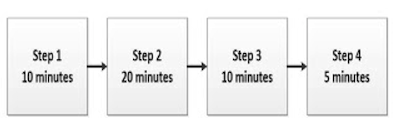
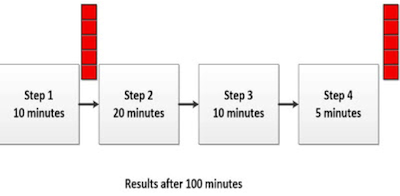
The figure above is a simple four-step process used to manufacture a product. Using the definition of efficiency, in order for Step 1 to achieve and sustain 100% efficiency, it would have to produce one product every ten minutes. Simple….right? But, in reality, what would happen after 100 minutes to this process if Step 1 continued producing one part every 10 minutes?

If Step 1 produced one part every 10 minutes and Step 2 could only process 1 part every 20 minutes, then Step 2 would only process 5 of the parts in 100 minutes. Step 3 would process all 5 of these parts as would Step 4. In other words, there would be 5 parts sitting directly in front of Step 2 waiting to be processed. This isn’t exactly what the results would look like, but for demonstration purposes, it will suffice. The point is, if Step 1 continued producing at its maximum capacity, the inventory would continue to build up in front of Step 2. Steps 1 and 2 would be operating at 100% efficiency, but what about Steps 3 and 4? Would it be possible for these two steps to reach 100% efficiency?

The problem with using efficiency as a performance metric is that it is controlled by the step with the least amount of capacity… the system constraint. The total system efficiency will always be less than 100 % simply because of the existence of the system constraint. The system efficiency for our process would be 100 % (Step 1) plus 100 % (Step 2), plus 50 % for Step 3, plus 25 % for Step 4 divided by 4 or 68.75 %. In fact, the only place where efficiency makes any sense at all is in the system constraint which in our process is Step 2.

The origins of operator efficiency lies in traditional cost accounting where the belief exists that everyone should be busy 100 % of the time. In our process it is clear that the operator in Step 3 would only be busy half of the time while the operator in Step 4 would only be busy one quarter of the time! The Cost Accountants would never stand for this and would be looking for manpower reductions!

So if operator efficiency isn’t a good performance metric (except in the constraint), then what is? In other words, how should we measure the performance of our 4-step process? In my next posting we’ll try to answer this question.

Bob Sproull

Bob Sproull is the author of Epiphanized: Integrating Theory of Constraints, Lean and Six Sigma. The book is a business novel and is an attention-grabbing and fast-paced story of the transformation of Barton Enterprises, a manufacturer of fuel tanks for the aviation and defense industry. To learn more about the book, click here >>

Throughput Accounting at Pittsburgh International

Throughput Accounting at Pittsburgh International 150 150 Novaces | Lean Six Sigma Training | Process Improvement | Healthcare | Government | Defense
Submitted By: Bob Sproull

The other day I was having a conversation at the Pittsburgh airport with a man that was carrying a copy of my book Epiphanized. He had so many questions for me and I was worried that I would miss my flight back to Georgia. I must admit that most of the questions were quite good and my answers settled a lot of issues in his mind. I thought in this posting that I would share one of the questions he had and how I answered it.

The first question he asked me had to do with Throughput Accounting. You see he was an accountant and didn’t understand why we needed a different accounting system when we had traditional Cost Accounting available. I just smiled and thought to myself, where should I start. I followed his question with a question of my own. I asked him if he thought manpower efficiency was a good metric and he immediately replied, “Yes, of course I do!” I asked him why he thought it was a good metric and, even though he had read our book, he told me that it was a great way to check on manpower requirements. He further said that if efficiency was low, then the workers weren’t doing their job. I then took out a piece of paper and drew my famous piping diagram.

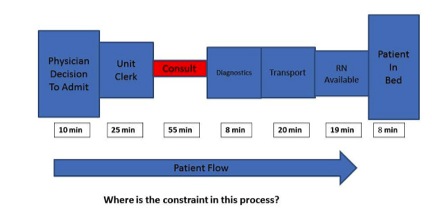
I asked him my usual question, “If you wanted to increase the amount of water flowing through these pipes, what would you have to do? He responded by saying, “That’s simple, you would have to increase the diameter of Section E.” I asked him why not just open up Section G’s diameter? He told me that would be stupid since no additional water would flow. So I then drew a simple Emergency Department process diagram and asked him the same question about what he would have to do to increase the number of patients passing through this process.

After giving it some thought, he said that the time for consult (55 minutes) would have to be decreased. I said, “You mean like the diameter having to be increased in the piping diagram?” He said yes. He then asked me what all this had to do with efficiencies? I asked him if he thought it would be a good idea to drive this ED process’s efficiency higher and he told me it would be a great idea. I then asked him how he would do this and his simple reply was, “Have everyone run their part of the process as fast as they could.” I then asked him what would happen if he ran the first two steps in this process as fast as they could? He thought about it for a bit and simply said, “I get it!” “If you run these steps as fast as you can, you’ll just stack up people waiting to consult with the physician.” We then talked about the steps after Consult and his conclusion was that they are at the mercy of the consult step. He had a much better idea of why I dislike efficiency so very much, but when I asked him what he thought about this metric now, he looked me square in the eye and simply said, “I need to go catch my flight.”

– Bob Sproull

Bob Sproull is the author of Epiphanized: Integrating Theory of Constraints, Lean and Six Sigma. The book is a business novel and is an attention-grabbing and fast-paced story of the transformation of Barton Enterprises, a manufacturer of fuel tanks for the avia

Update #2 on Emergency Department “Door to Doc” Time

Update #2 on Emergency Department “Door to Doc” Time 150 150 Novaces | Lean Six Sigma Training | Process Improvement | Healthcare | Government | Defense

Submitted By: Bob Sproull

The Emergency Department improvement team began developing their current state process map and found out very early on that imagining their process and getting it down on paper was not an easy task.  There were disagreements for sure on how the actual process looks, but the most difficult thing was deciding how to map out the five different scenarios that existed within their ED as follows:

Scenario 1:  Patient enters the ED and is moved directly to an ED bed.

Scenario 2:  Patient is triaged (Triage 1), moves to the patient waiting room, patient is triaged (Triage 2), and finally is moved to an ED bed.

Scenario 3:  Patient is triaged (Triage 1), then immediately triaged again (Triage 2), then moves to a waiting room and then is moved to an ED bed.

Scenario 4:  Patient is triaged (Triage 1), then moves to the waiting room, then is triaged again (Triage 2), then moves back to the waiting room, then finally is moved to an ED bed.

Scenario 5:  Patient is triaged (Triage 1), then immediately to Triage 2, then immediately to the ED bed.

The team was struggling on how best to map these individual processes and could not see an easy way to do so.  I asked them a series of questions as follows:

  1. Which scenario is the fastest?  They assured me that Scenario 1 was much faster than any of the others.
  2. Which scenario is the slowest?  They told me that Scenario 4 was by far and away the slowest.
  3. Which scenario is most commonly used for patients and they told me that Scenario 4 was used for about 80% of the patients.

The team asked me what they should do and I simply told them that since Scenario 4 applied to 80 % of the patients that they should focus their efforts on that one since it represents the largest opportunity to improve both the cycle time and patient satisfaction metrics.  This was a classic case of the infamous Pareto Principle meaning that 80% of their improvement will come from 20% of their scenarios (i.e. 1 of 5 scenarios).

I also explained that they should also review what things aren’t done in Scenario 1 that make it much faster than any of the others.  This could in fact become their Ideal State and help them create a future state that meets all of their performance objectives.

The team has completed their first draft of the current state process map and will complete it tomorrow.  They will also be completing their value stream analysis by categorizing each step as value-added (color-coded as Green), non-value-added (color-coded as Red) and non-value-added but necessary (color-coded as Yellow).  When this is completed the team will then create their ideal and future state maps.

One problem the team rightfully pointed out was that it is relatively easy to “speed-up” the front end of the process by reducing the time it takes to get the patient to the ED Exam Room, but getting the doctor to the exam sooner is going to be difficult.  We then created an Interference Diagram (ID) to better understand what gets in the way of reducing the time it takes for the doctor to see the patient.  Figure 1 is the ID the team created.

Figure 1

The team then began looking for potential solutions for each of the interferences listed in the ID which I will report on in my next posting.

Bob Sproull

A Gift of a Good Book and an Epiphany

A Gift of a Good Book and an Epiphany 150 150 Novaces | Lean Six Sigma Training | Process Improvement | Healthcare | Government | Defense
Submitted By: Bob Sproull

I want to share a story about a very powerful and influential gift that was given to me… a copy of ‘The Goal’ by Eli Goldratt. As I read ‘The Goal’ I began to visualize how I could apply the many lessons I had read about. I asked myself, “Could I actually utilize Goldratt’s teachings in the real world?” After all, this was only a fictional setting and there really wasn’t an Alex Rogo. It wasn’t apparent how I would use this information until the early 90’s when I had an epiphany or maybe some would say an out-of-body experience! Goldratt’s simple, yet elegant message of identifying, deciding how to exploit the system constraint and subordinating everything else to the constraint changed me forever.

In addition, to the concept of constraints, Goldratt introduced me to what he called Throughput Accounting. Specifically, Throughput (T), Inventory (I) and Operating Expense (OE) took on a whole new meaning for me. It became apparent to me that reductions in inventory typically have a one-time impact on cash flow and after that little can be gained. It was also evident that operating expense had a functional lower limit and once you hit it, you could actually do more harm than good to the organization by reducing it further. Throughput, on the other hand, theoretically has no functional upper limit! But more importantly, throughput was only throughput if money exchanged hands with the customer. That is, producing products for sale is just not the same as receiving cash for them because, in reality, it’s simply inventory.

Learning about constraints and throughput accounting transformed me back then. I came to the realization that everything I do in the name of improvement would give us a better return on investment if we focused our efforts on the operation that is limiting throughput. I decided then and there that constraints are the company’s leverage points and if I wanted to maximize our profits, then our primary improvement efforts should be focused on the constraints. So off I went and the results were immediate and significant. Our on-time delivery sky rocketed! Our profits rose at an unprecedented rate and everything was good in the world. Good until the constraint moved that is! All of a sudden my world came crashing in on me because I hadn’t anticipated this. I should have, but I didn’t. It wasn’t hard to find the new constraint since there was a pile of inventory sitting in front of it. So we just moved our improvement efforts to the new constraint. I learned what Goldratt meant about “breaking the constraint.”

– Bob Sproull

Bob Sproull has since authored Epiphanized: Integrating Theory of Constraints, Lean and Six Sigma. The book is a business novel and is an attention-grabbing and fast-paced story of the transformation of Barton Enterprises, a manufacturer of fuel tanks for the aviation and defense industry. To learn more about the book, click here >>

Healthcare Performance Improvement: Yesterday, Today, and Tomorrow (Part 2)

Healthcare Performance Improvement: Yesterday, Today, and Tomorrow (Part 2) 150 150 Novaces | Lean Six Sigma Training | Process Improvement | Healthcare | Government | Defense

Submitted By: Dan Chauncey

Today

Many put the start of the quality revolution with the NBC Television’s show “NBC White Paper.” On June 24, 1980 Lloyd Dobbins introduced W. Edwards Deming to America in an episode entitled: If Japan can… Why can’t we?

The show addressed how Deming’s advice on continuous process improvement and recognizing that manufacturing is a system, not simply separate assembly steps. While the application of what came to be called TQM was applied sporadically within healthcare, the use of PDCA seemed to take hold and became widespread in its use. Not only did it align nicely with the scientific method widely understood in healthcare, but gained momentum when it was modified with the addition of the set of preliminary steps: FOCUS, by Hospital Corporation of America (currently the largest private operator of health care facilities in the world). It is not known whether the expansion of its use was based on efficacy or the notoriety of its developer.

While many quality theories or approaches were short-lived, three seemed to take hold—albeit independent of each other. Starting in manufacturing, these three methods have survived to improve quality and efficiency: Lean, Six Sigma, and Constraints Management. Throughout the 1990s, these methodologies began to be applied in other industries. Despite successes wherever applied, certain industries have been slower to accept certain quality tools and methods from manufacturing despite more than 30 years of successful application. It is critical to note that the finding is about acceptance, not applicability; for example, while control charts have been used extensively in manufacturing since the 1920s and have been used successfully in healthcare, their usage is not as widespread as one would expect.

Lean in Healthcare

Lean focuses on eliminating waste. Most literature lists seven different types of waste (shown below). While these were developed originally for applicability within manufacturing, they are equally relevant in healthcare.

Transport. Any time people, materials, or information must be moved, it is defined as waste. Moving patients from room to room is an example of waste. While in many cases necessary, this transportation nonetheless is viewed as waste. Use of a spaghetti diagram may help to minimize this type of waste.

Inventory. While it is necessary to maintain inventories to ensure availability, anything short of just-in-time (JIT) availability is categorized as waste. Tools such as kanban can mitigate this kind of waste.

Motion. A nurse’s station with a desktop computer at one end and a printer at the other that requires nurses to move excessively to pick up printouts is an example of waste. Good ergonomic practices and more efficient workspace layouts can moderate this waste.

Waiting. This waste is endemic to healthcare. We even call our primary customers patients—is this because it is an expectation? Elimination of non-value-adding activities can diminish this waste.

Overproduction. Running too many tests and printing too many copies of paperwork are examples of overproduction. Reviewing standard lab panels or pursuing paperless processes can mitigate this type of waste.

Overprocessing. Requiring excess approvals and running the same test twice are examples of overprocessing. The elimination of non-value adding activities can lessen this sort of waste dramatically.

Defects. When a product or service does not meet specification or customer expectations, it is a defect. Defects often result in rework, and the associated costs frequently go unaccounted for.

Six Sigma in Healthcare

The power of Six Sigma is its ability to identify root causes of complex problems and reduce variation, both of which are central to the improvement of processes. Examples of Six Sigma applications in healthcare include reduction of infection rates, patient falls, and missed appointments, as well as enhanced medication reconciliations and coding. Anywhere the root cause is not known. While historically, the concept of root cause analysis in healthcare process improvement has relied largely on softer tools such as Failure Modes and Effects Analysis and Fishbone Diagrams; Six Sigma relies on the use of inferential statistics to validate root causes.

Constraints Management in Healthcare

Constraints Management is a management philosophy encompassing an integrated suite of techniques used in operations and supply-chain management, project management, conflict resolution, and   strategic planning. Dr. Eliyahu Goldratt began its development in 1979 with the production scheduling software OPT, and has led its evolution into three interrelated areas—logistics/production, performance measurement, and problem-solving/thinking tools.

It is a systematic approach to managing complex organizations by identifying and controlling key leverage points within a system or process. By managing these key control points, healthcare organizations can focus on areas that drive system-level improvement instead of trying to manage every element of a process, which can lead to local optimization without systemic impact.

A constraint is anything that limits the system from achieving higher performance relative to its goal. In healthcare, a constraint is anything that impedes the ability or means to provide or deliver care. Common types of constraints include:

  • Market
  • Resource
  • Material
  • Supplier/vendor
  • Financial
  • Knowledge/competence
  • Policy

Once the constraint is identified, numerous tools are available to mitigate it. Within healthcare, Constraints Management was pioneered at the University of Pretoria Medical School in 1991. One of the earliest reported applications of Constraints Management in U.S. healthcare was at the University of Michigan Hospital. The hospital’s admission and discharge system was inefficient, resulting in an average of three hours’ delay in accepting incoming patients, who waited for their rooms to be prepared. Constraints Management allowed the hospital to reduce the average time to admit patients from 3 hours to just 11 minutes.

Transition to an Integrated Approach

Each of these methodologies has stood the test of time; each has been around as a distinct entity for more than 30 years. The problem is that most people tend to be in one camp or another. After years or practice and much research, we (NOVACES) have come to the—not so shocking—conclusion that one should apply the right tool to the right problem at the right time.

If you are looking for focus: you might look in the Constraints Management section of your toolbox, root cause analysis: Six Sigma section; improving flow: the Lean section. Maybe even sometimes, you might have to pull something from a couple of sections to solve the same issue!

Novaces | Lean Six Sigma Training | Process Improvement | Healthcare | Government | Defense