Process Improvement Tools

Throughput Accounting at Pittsburgh International

Throughput Accounting at Pittsburgh International 150 150 Novaces | Lean Six Sigma Training | Process Improvement | Healthcare | Government | Defense
Submitted By: Bob Sproull

The other day I was having a conversation at the Pittsburgh airport with a man that was carrying a copy of my book Epiphanized. He had so many questions for me and I was worried that I would miss my flight back to Georgia. I must admit that most of the questions were quite good and my answers settled a lot of issues in his mind. I thought in this posting that I would share one of the questions he had and how I answered it.

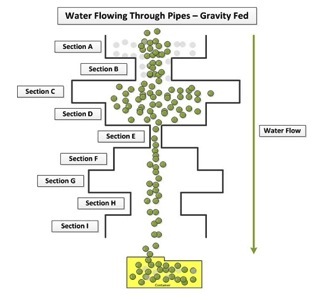
The first question he asked me had to do with Throughput Accounting. You see he was an accountant and didn’t understand why we needed a different accounting system when we had traditional Cost Accounting available. I just smiled and thought to myself, where should I start. I followed his question with a question of my own. I asked him if he thought manpower efficiency was a good metric and he immediately replied, “Yes, of course I do!” I asked him why he thought it was a good metric and, even though he had read our book, he told me that it was a great way to check on manpower requirements. He further said that if efficiency was low, then the workers weren’t doing their job. I then took out a piece of paper and drew my famous piping diagram.

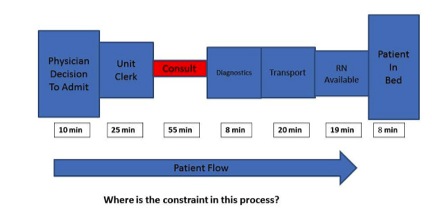
I asked him my usual question, “If you wanted to increase the amount of water flowing through these pipes, what would you have to do? He responded by saying, “That’s simple, you would have to increase the diameter of Section E.” I asked him why not just open up Section G’s diameter? He told me that would be stupid since no additional water would flow. So I then drew a simple Emergency Department process diagram and asked him the same question about what he would have to do to increase the number of patients passing through this process.

After giving it some thought, he said that the time for consult (55 minutes) would have to be decreased. I said, “You mean like the diameter having to be increased in the piping diagram?” He said yes. He then asked me what all this had to do with efficiencies? I asked him if he thought it would be a good idea to drive this ED process’s efficiency higher and he told me it would be a great idea. I then asked him how he would do this and his simple reply was, “Have everyone run their part of the process as fast as they could.” I then asked him what would happen if he ran the first two steps in this process as fast as they could? He thought about it for a bit and simply said, “I get it!” “If you run these steps as fast as you can, you’ll just stack up people waiting to consult with the physician.” We then talked about the steps after Consult and his conclusion was that they are at the mercy of the consult step. He had a much better idea of why I dislike efficiency so very much, but when I asked him what he thought about this metric now, he looked me square in the eye and simply said, “I need to go catch my flight.”

– Bob Sproull

Bob Sproull is the author of Epiphanized: Integrating Theory of Constraints, Lean and Six Sigma. The book is a business novel and is an attention-grabbing and fast-paced story of the transformation of Barton Enterprises, a manufacturer of fuel tanks for the avia

Update #2 on Emergency Department “Door to Doc” Time

Update #2 on Emergency Department “Door to Doc” Time 150 150 Novaces | Lean Six Sigma Training | Process Improvement | Healthcare | Government | Defense

Submitted By: Bob Sproull

The Emergency Department improvement team began developing their current state process map and found out very early on that imagining their process and getting it down on paper was not an easy task.  There were disagreements for sure on how the actual process looks, but the most difficult thing was deciding how to map out the five different scenarios that existed within their ED as follows:

Scenario 1:  Patient enters the ED and is moved directly to an ED bed.

Scenario 2:  Patient is triaged (Triage 1), moves to the patient waiting room, patient is triaged (Triage 2), and finally is moved to an ED bed.

Scenario 3:  Patient is triaged (Triage 1), then immediately triaged again (Triage 2), then moves to a waiting room and then is moved to an ED bed.

Scenario 4:  Patient is triaged (Triage 1), then moves to the waiting room, then is triaged again (Triage 2), then moves back to the waiting room, then finally is moved to an ED bed.

Scenario 5:  Patient is triaged (Triage 1), then immediately to Triage 2, then immediately to the ED bed.

The team was struggling on how best to map these individual processes and could not see an easy way to do so.  I asked them a series of questions as follows:

  1. Which scenario is the fastest?  They assured me that Scenario 1 was much faster than any of the others.
  2. Which scenario is the slowest?  They told me that Scenario 4 was by far and away the slowest.
  3. Which scenario is most commonly used for patients and they told me that Scenario 4 was used for about 80% of the patients.

The team asked me what they should do and I simply told them that since Scenario 4 applied to 80 % of the patients that they should focus their efforts on that one since it represents the largest opportunity to improve both the cycle time and patient satisfaction metrics.  This was a classic case of the infamous Pareto Principle meaning that 80% of their improvement will come from 20% of their scenarios (i.e. 1 of 5 scenarios).

I also explained that they should also review what things aren’t done in Scenario 1 that make it much faster than any of the others.  This could in fact become their Ideal State and help them create a future state that meets all of their performance objectives.

The team has completed their first draft of the current state process map and will complete it tomorrow.  They will also be completing their value stream analysis by categorizing each step as value-added (color-coded as Green), non-value-added (color-coded as Red) and non-value-added but necessary (color-coded as Yellow).  When this is completed the team will then create their ideal and future state maps.

One problem the team rightfully pointed out was that it is relatively easy to “speed-up” the front end of the process by reducing the time it takes to get the patient to the ED Exam Room, but getting the doctor to the exam sooner is going to be difficult.  We then created an Interference Diagram (ID) to better understand what gets in the way of reducing the time it takes for the doctor to see the patient.  Figure 1 is the ID the team created.

Figure 1

The team then began looking for potential solutions for each of the interferences listed in the ID which I will report on in my next posting.

Bob Sproull

NOVACES will be making a Special Breakfast Presentation at the 24th IHI

NOVACES will be making a Special Breakfast Presentation at the 24th IHI 150 150 Novaces | Lean Six Sigma Training | Process Improvement | Healthcare | Government | Defense

Intermediate Objectives Map – A Great Planning and Execution Tool

Submitted By: Bob Sproull

Many people who have gone through a TOC Jonah training session have come away overwhelmed and sometimes feeling like they are unable to apply what they’ve learned.  Let’s face it, the TOC Thinking Process tools are just not easy for some people to grasp and apply, so they kind of put them on the back-burner rather than taking a chance of doing something wrong.  Well, for everyone who fits into this category, I have hope for you.  What if I told you there was a logic diagram that is actually simple to construct  and one that you would feel confident using?  Would that be of interest to you?  There is such a tool and it’s called an Intermediate Objectives Map.  Yes, I’ve had other posts about this tool in the past, but I want to show you a different way to use the IO Map.  But before I do, let’s review the basics of the IO Map.

I remember going through the Jonah course and of all of the TOC Thinking Process tools I learned, the IO Map stood out for me because of its simplicity.  Since then I have used the IO Map in a variety of different settings and in every instance the leadership team not only understood it, but actually embraced it.  The beauty of the IO Map is that everything that must be in place to achieve the goal of the organization is included on a single sheet of paper.

Bill Dettmer tells us of his first exposure to IO Maps back in 1995 during a management skills workshop conducted by Oded Cohen at the Goldratt Institute.  In recent years, Dettmer has recommended that the IO Map, which he now refers to as a Goal Tree, should be the first step in a Thinking Process analysis.  He believes this because it defines the standard for goal attainment and its prerequisites in a much more efficient manner.  I believe that the IO Map is a great focusing tool to better demonstrate why an organization is not meeting its goal.  Other advantages of using an IO Map include a better integration of the rest of the TP tools and will accelerate the completion of Current Reality Trees, Conflict Clouds and Future Reality Trees.  The other thing I like about IO Maps is that they can be used as a stand-alone tool which results in a much faster analysis of the organization’s weak points or in conjunction with the other TOC TP Tools.  In this posting we will discuss the IO Map as a stand-alone tool.

When using the logic based TOC Thinking Process tools there are two distinctly different types of logic at play, sufficiency type logic and necessity type logic.  Sufficiency type logic is quite simply a series of if-then statements.  If I have this, then I have that.  Necessity-based logic trees use the syntax, “in order to have this……I must have that. The IO Map falls into the necessity-based category.  For example, in order to have a fire, I must have a fuel source, a spark and air. If the goal is to have a fire, I must have all three components.  Take away even one of the CSFs and I won’t have a fire.

The hierarchical structure of the IO Map consists of a single Goal, several Critical Success Factors (CSFs) which must be in place to achieve the goal and a series of Necessary Conditions (NCs) which must be in place to achieve each CSF. The Goal and CSFs are written as terminal outcomes that are already in place.  Let’s look at an example of what an IO Map might look like.

Suppose that you were working with an organization who wants to become a highly profitable one.  You assemble the CEO and key members of his staff to develop an effective plan to achieve this goal.  In the IO Map drawing below, after much discussion, you agree on your Goal as “Highly Profitable Company” and place it inside the Goal box. This goal statement is written as a terminal outcome as though it’s already been achieved.  In the IO Map below, the Goal is stated as “Highly Profitable Company” which is the desired end state.  You think to yourself, “What must I have in place for our goal to be realized?” You think, “I know that we must have highly satisfied customers for sure and that our throughput must be high and growing,” so you place both of these in separate CSF boxes.  One-by-one you continue listing those things that must be in place to achieve your goal and place them into separate CSF boxes like the figure below.  In an IO Map you should have no more than 3 to 5 CSF’s.
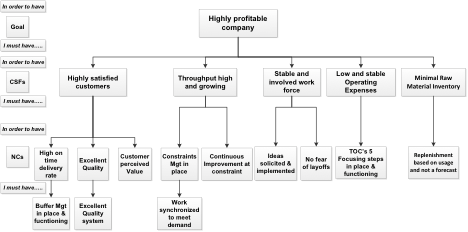
Because the IO Map uses necessity–based logic, it is read in the following way: “In order to have a highly profitable company, I must have highly satisfied customers as well as the other four CSF’s.  Directly beneath the CSFs are NCs that must also be in place to achieve each of the CSFs. So continuing to read downward, “In order to have highly satisfied customers, I must have three different NCs as described in the IO Map above.  Remember, the CSF’s are written as terminal outcomes, as though they’re already in place.  You continue reading downward, in order to have, for example, high on-time delivery rate, I must have buffer management in place and functioning.  The NC’s represent actions that must be completed to achieve each individual CSF and form the basis for your improvement plan.  In like manner, your team completes all of the NCs until you are satisfied that what you have in place on the IO Map will ultimately deliver the goal of the organization. Typically in an IO Map, there are three-to-five CSFs and no more than two-to-three layers of NCs.  OK, so what happens next?

Here’s where I’ve departed from the traditional TP tools in that the next step would be to use the IO Map to construct a Current Reality Tree.  And although I totally support this approach, when time is a factor, I continue on with the IO Map in this way.  I typically facilitate a critical discussion on the status or current state of the Goal, CSFs and NCs.  I use a simple Green, Yellow and Red coding system to describe how each of the IO Map entities exists in our current reality.  The figure below is a summary of that exercise for our hypothetical company.
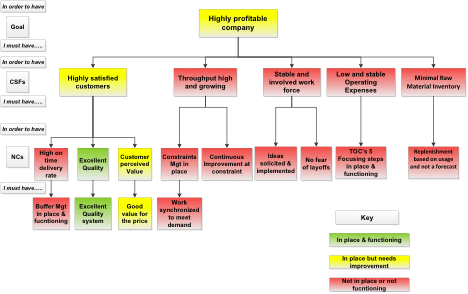
Notice the key on the bottom right hand side of the IO Map and you’ll see that a box shaded in green indicates that the entity is in place and functioning so no changes need to be made.  A yellow box indicates that there is something in place, but that it needs improvement.  A box shaded in red means that the entity is either not in place or that something is in place, but it isn’t functioning.  It should be obvious that any entity shaded in red has a higher priority than one shaded in yellow.

In our example, because the company is at least minimally profitable, but not highly profitable, it is shaded in yellow.  If we look at the CSFs, four of the five CSFs are shaded in red meaning that each is either not in place or simply not functioning well enough to drive higher profitability.  In this hypothetical company it appears as though the only thing this company is doing right is their excellent quality and it’s because they have excellent quality systems in place.  But other than their quality systems, not much else is functioning well.  Let’s look now at several of the NCs that must be worked on to satisfy the CSFs.

For the first CSF, Highly Satisfied Customers, we see that the leadership team believes that three things must be in place to satisfy this CSF:

  1. They must have high on-time delivery rates and because it’s shaded in red, this probably isn’t happening or at least not to the level to highly satisfy their customers.  The team further stated that in order to have high on-time delivery rates, they must have buffer management in place and functioning.
  2. They must also have excellent quality and because this entity is shaded in green, the team believes that their quality is excellent due to their excellent quality systems.
  3. Finally, they must have a high perceived value by the customer and since it’s shaded in yellow, the team doesn’t believe this is the case.  The team believes that this is being driven primarily by the price of their products, but it’s probably also due to their poor on-time delivery rates.

In the second CSF, Throughput High and Growing, the red shading indicates that this company has significant room to grow.  This company had been through TOC training which included a section on Throughput Accounting and they now understand that their throughput is driven by managing the system constraint and by focusing their improvement efforts only on the constraint.  The team now believes that in order for constraints management to function well, they must have work synchronized to meet demand.  Similarly, if we look at each of the remaining CSFs and associated NCs we have a much better understanding of what actions need to take place in order to ultimately drive profitability higher.

The key to creating a focused improvement plan, using the IO Map, is to develop the improvement plan around what the Necessary Conditions are telling us.  If we look at the figure below and scrutinize it, we see that there are four primary improvement projects which, if implemented correctly, will drive improvement to each of the five Critical Success Factors and ultimately achieve our goal.

  1. Implement TOC’s Drum Buffer Rope.  This project will impact two CSFs, Highly Satisfied customer by improving the on-time delivery rate and Throughput High and Growing by synchronizing work to meet demand.
  2. Implement an integrated Lean, Six Sigma and Constraints Management, but only at the system constraint.  In so doing, this will automatically drive throughput higher and will continue to do so when the constraint moves.
  3. Implement Active Listening.  Active listening is the process of soliciting and implementing solutions provided by the subject matter experts, the people building the product or delivering the service.  In my experience, this will also have an immediate, positive impact on the morale of the work force.
  4. Implement Dynamic Replenishment.  One of the keys to profitability is to reduce inventory and avoid part’s stock-outs and by implementing a replenishment system based upon usage rather than a forecast.  In so doing, two dramatic improvements will take place.  Overall inventory will decrease by at least 40% and part’s stock-outs will virtually disappear.  These two benefits occur because part’s replenishment will now be based upon actual consumption and not a forecast.
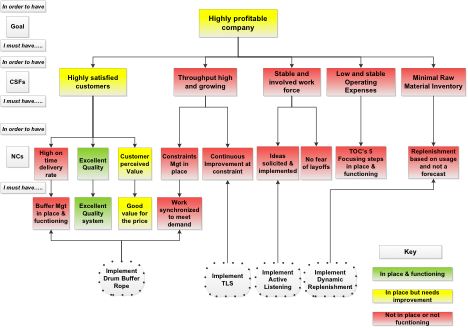
So here it is, a different way to utilize an Intermediate Objectives Map which is easy both to understand and construct and which permits the development of a very focused improvement plan.  In my experience using this approach, the team that develops it, will embrace it because it is their plan.  And the good news is, from start to finish it only takes less than a day, rather than days or weeks to develop.

Bob Sproull

Healthcare Performance Improvement Mistake 9: Measure Twice, Cut Once

Healthcare Performance Improvement Mistake 9: Measure Twice, Cut Once 150 150 Novaces | Lean Six Sigma Training | Process Improvement | Healthcare | Government | Defense
Submitted By: Brian MacClaren

Do you believe your organization has too many performance measures or too few? Having good data available enables better decisions to be made, but not when the expense of collecting all the data is so high that it severely limits your resources to fix problems and improve quality. This results in a lot of measuring, but rarely a chance to make the cut.

If asked if you believe your organization has too many different measures or too few, how would you answer?

a) We have way too many metrics, but they all provide valuable information
b) We have too many metrics and they don’t provide the information we need
c) We have just the right amount of metrics to balance the need for information and action
d) We have too few metrics to adequately measure performance

If you answered “c,” then you are among those who have implemented a performance management system that truly works for the entire organization. Sometimes we only have the resources to track required measures like CMS Core Measures. Or, we might track so many different measures that at time we believe we are some kind of data manufacturing company instead of a hospital. In this case, it feels like more time is spent compiling data and reports than actually working on improvement projects.

So, what are the characteristics of a good performance measurement system?

The system must be designed as a tool for tracking financial results while simultaneously monitoring the system’s capabilities to meet customer needs, key performance indicators, and critical success factors.

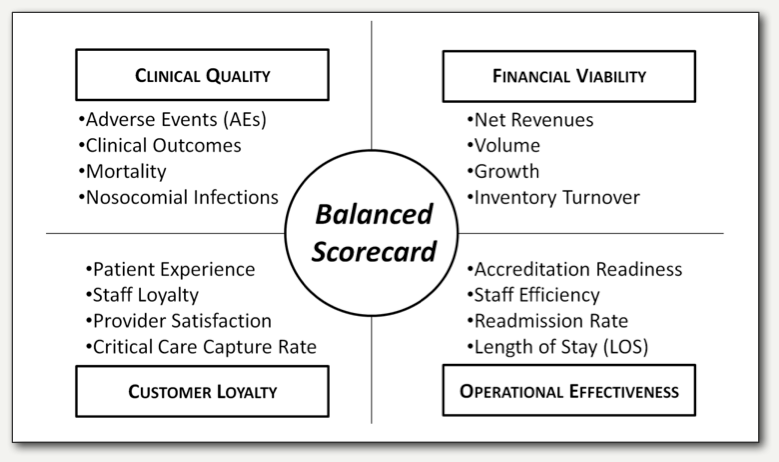
At the executive level, the system represents the acme of a hierarchy of indicators that, ultimately, reach both the bedside and the loading dock. Ideally, each employee knows how his or her work impacts the uppermost corporate indicators. Given these considerations, many organizations seek to implement the balanced scorecard.

Example of a balanced scorecard.

Although the balanced scorecard represents a vision and a benchmark for measuring performance in an organization, the first step is beginning to design effective performance measures. Here are some things to think about when doing just that:

  • Indicators are specific. A hierarchy of metrics links layers of accountability so that staff at every level of the organization are measured on their contribution to metrics at the highest level. There is a clear line of sight upward, from each worker’s job to the executive dashboard and from the dashboard down to division and departmental indicators and the specific activities moving the dial.
  • Indicators are logical and based on clear operational definitions. process capability and performance against objectives is quantifiable.
  • Indicators are actionable. performance improvements can be linked directly to changes in performance indicators
  • Indicators are relevant. Everything that matters (the critical few indicators defined by organizational strategy) is measured and nothing more.
  • Indicators are related to time. Performance over time (trending) is evident and key processes are measured frequently enough to allow for timely corrective action.

As we work towards moving our organizations to “answer c,” the effort will certainly require a collaborative effort involving all stakeholders to find the most efficient use of the organization’s valuable resources. It will be an effort to separate the “critical few” from the “trivial many.”

The Interference Diagram

The Interference Diagram 150 150 Novaces | Lean Six Sigma Training | Process Improvement | Healthcare | Government | Defense
Submitted By: Bob Sproull

For those of us engaged in performance improvement initiatives there seems to be a constant bombardment of “things” that seem get in the way of what we’re trying to accomplish.  Things that interfere with our attempts to achieve a goal or objective in our quest to make things better.  Some of these things come out of nowhere in the name of uncertainty to stifle our efforts and still others are there just waiting to be found and acted upon.  Wouldn’t it be great if there was a way, or at least a tool, to help visualize these “things” so that we could do something about them?  Life would be so much easier wouldn’t it?  Good news….such a tool does exist for identifying the myriad of business, production, healthcare and manufacturing issues that face us every day.  It’s called an Interference Diagram (ID).

Most of you have probably never have seen or even heard of an ID before.  Its origins date back to the mid-1990’s with Bob Fox and the TOC Center in New Haven, Connecticut.  As a thinking tool it has not been well publicized and as such, is not well known.  But just because it hasn’t been well publicized, don’t underestimate its importance from a problem solving perspective. The endearing qualities of the ID is that it’s both simple to learn and construct and is quite robust in its application.  The ID is a thinking tool that offers the capacity to define and visualize those interferences or obstacles that block or hinder your ability to achieve a specific goal or outcome.  It’s always far easier to define what we want, but much more difficult to define why we can’t have it and the ID helps us do that.

The ID can be used at many different organizational levels to understand why things at all levels don’t happen or work the way we want them to.  The ID can be used as a stand-alone tool or it can be used in conjunction with other tools, so its uses are multiple.  As a stand-alone tool it provides a discrete analysis to better define and understand the obstacles that prevent accomplishment of our goal. But in a broader application it can be used to supplement the other, more common systems thinking tools developed by Dr. Goldratt as well as his Five Focusing Steps.  No matter which way it is used, the end results can be very dynamic.

The Interference Diagram is quite simple to construct as depicted in Figure 1.  The first step in its construction is to decide what it is you want more of or what your goal or objective is.  When you’ve decided what that is, write it inside the circle in the center of a white board or piece of paper.  Make sure that whatever you write here is a succinct, precise statement so that it’s easy to work with.


FIGURE 1

After you’ve considered and recorded what it is you want more of, think to yourself “What prevents me from getting more of what I want?” The answer to this simple question becomes the interferences that you record in the boxes surrounding your goal.  Continue to list your interferences until you are satisfied that your list is complete enough to move on.  There are really no rules that govern a specific number of interferences you can list, just be sure to list the major interferences as to why you can’t achieve what it is that you want more of.  Make sure you include things that you might think you can’t do anything about like lunches and breaks.

If your ID analysis is such where time is an important factor, then it is important to quantify your interferences as a function of time.  In other words, how much time does this particular interference take away from what you want?  If time is a factor, and most of the time it will be, then it’s important to keep the time element constant.  That is, record the time element for each individual interference using the same measure, such as minutes or hours or whatever measure you select per day or week. As you will see shortly, this will help you prioritize your interferences in terms of importance and action.  Let’s look at an example.

In this example, suppose you are working in an aviation maintenance, repair and overhaul (MRO) facility and you are responsible for increasing the number of aircraft available on a daily basis.  You haven’t been meeting your contractual targets, so you’ve been receiving large $ penalty losses.  Let’s assume you have already completed a process analysis using a process map or value stream map and have determined the location of your system constraint to be the wait time required to get necessary approvals to permit your maintenance work to begin on the aircraft.  In this scenario you assemble a team of subject matter experts, the people maintaining, repairing and overhauling the aircraft, and you begin construction of an ID.  Since your constraint has been identified as the wait time to begin work on the aircraft, you decide that your goal should be, “Reduced wait time to begin repairs.”   You ask the team the following question, “What is preventing you from beginning work on the aircraft sooner?” One-by-one you then record both the interference the team members have described as well as an “estimate” or “guesstimate” of how much time is being lost for each one.

Figure 2 is an example of the responses (i.e. interferences and estimated times) you received from the team members and the populated boxes surrounding your goal.  If you just eyeball the interferences, you can see that Incorrect Assignments is the largest impediment to reducing the wait time to begin repairs at 210 minutes per week.  This is followed by paperwork and waiting for the rinse crew at 120 minutes each.  Once you feel confident that you have captured the predominant interferences, I recommend that you create either a Pareto Chart or a Pie Chart to prioritize the interferences.


FIGURE 2

Figure 3 is the Pareto Chart of repair time minutes lost per week as a result of the interferences identified by the team of SME’s.  The Pareto Chart reflects the priority order to “attack” these interferences to authorize repairs to begin sooner on the aircraft.


FIGURE 3

I mentioned earlier that the ID can be used at different levels, so let me provide an example.  Suppose that one of the major interferences was getting the necessary paperwork to the mechanics.  You assemble the core team again and decide that the goal is to “Reduce Time Waiting for Mechanic’s Paperwork.”  You then ask the team, “What is preventing you from getting the necessary paperwork sooner?”  As described earlier, the team then provides a list of interferences and time estimates that are blocking achievement of this goal.

Figure 4 is an example of this lower level Interference Diagram and as you might expect, there are few interferences listed, but they are much more specific than those in the original ID.  In this example, the team decided if they could come up with a way to stop batching “Daily Cards” the process would improve significantly.  Because of the travel time from the flight line to Maintenance Control (the final location for the Daily Cards) the team recommended purchase of scanners so that a copy of the cards could be emailed to Maintenance Control rather than holding them as batches and transporting them to MC at breaks and lunches.

The Interference Diagram is a thinking process tool that is based more on experience and intuition rather than logic, but it is a tool that has proved to be invaluable in terms of visualizing organization problems at all levels.


FIGURE 4

Visit our YouTube channel to watch a short video of Bob Sproull presenting an Aviation Maintenance Case Study:

http://www.youtube.com/watch?v=PXNLvkWtQVw

If you would like the full slide set of the case study presentation please contact Morgan Bowman at mbowman@novaces.com

Novaces | Lean Six Sigma Training | Process Improvement | Healthcare | Government | Defense