


Gauging the Influence of Increased Search Effort on Reporting Rates of Bottlenose Dolphins
Client: BP Exploration and Production (BPXP)
Following the Deepwater Horizon (DWH) oil spill in April 2010, widespread response efforts were launched across the northern Gulf of Mexico (nGOM). This study, conducted by researchers and partners including NOVACES, aimed to quantify the influence of increased search effort on the number of bottlenose dolphin (Tursiops truncatus) strandings reported between 2010 and 2015. As oil spill response teams regularly surveyed the shoreline, concerns arose about the extent to which their presence elevated reported strandings compared to actual mortality rates. The project involved spatial and statistical analyses using nearly two decades of marine mammal stranding data to isolate the effect of response-related reporting.
Challenges
The longest Unusual Mortality Event (UME) on record in the nGOM—spanning over four years—raised questions about the actual causes and scale of bottlenose dolphin deaths. Questions persisted related to the ongoing UME being influenced by the Deepwater Horizon oil spill. However, drawing accurate conclusions about mortality was hindered by potentially inflated stranding numbers driven by increased search presence rather than increased death rates. Without clearly distinguishing between natural stranding rates and those artificially elevated by oil spill response activity, understanding population impacts and planning for future restoration was difficult.
Solutions Delivered
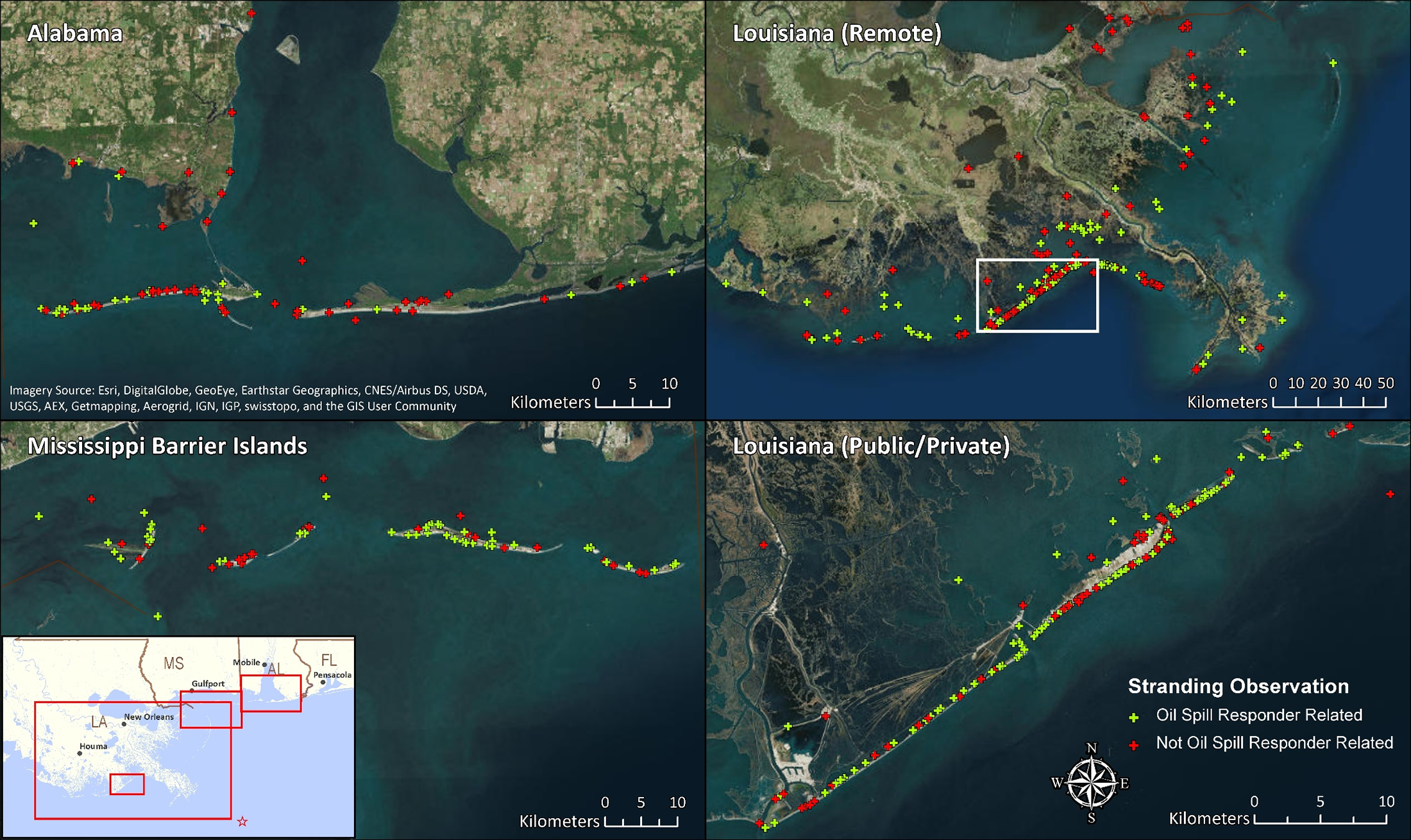
Researchers examined 1,941 stranding records across Louisiana, Mississippi, and Alabama, filtering for geographic accuracy and isolating bottlenose dolphin strandings. Using Level A data and oil spill responder activity records, stranding observations were categorized as response-related or not. A total of 58% of dolphin stranding observations during the Active Response period (May 2010–April 2014) were linked to oil spill responders. Statistical comparisons using Poisson rate tests and U-Charts showed that once response-related records were removed, monthly stranding rates during the Active Response period resembled those of the post-cleanup period (Post-RADC).
Spatial analyses using Getis-Ord Gi* statistics further revealed that excluding response-related stranding observations reduced significant clustering of strandings in Louisiana by 48%. These results demonstrate that the apparent increase in dolphin strandings was primarily due to increased surveillance rather than an actual rise in mortality.
Key Takeaways
Increased search effort during the DWH response significantly inflated reported dolphin strandings—58% of observations were response-related.
Once response-related records were removed, stranding rates during and after the spill response period were statistically similar.
Spatial clustering of strandings dropped by nearly half when response-linked records were excluded, highlighting the role of observer effort.
Future assessments of marine mammal mortality must consider search effort, detection rates, and public awareness when interpreting stranding data.
This study provides a replicable method for adjusting mortality estimates to account for elevated observation conditions, improving data accuracy for protected species management.