
Leading Change

Maintaining Business Continuity in Crisis – COVID-19

Maintaining Business Continuity in Crisis – COVID-19 150 150 Novaces | Lean Six Sigma Training | Process Improvement | Healthcare | Government | Defense
Submitted By: Brian MacClaren

Author: Paul Dean, NOVACES (Washington, D.C.)

Amidst the uncertainty of the current environment, the currency of information expires within a few short weeks, sometimes merely within days.  Indeed, the global outlook in February 2020 is entirely alien in the context of what we now know two months later.  However volatile our predicament may seem though, two things are certain: the pandemic of COVID-19 will ultimately end, and another pandemic looms on the horizon.  While it is exceedingly difficult to consider returning to the status quo, it is imperative that leadership aligns business objectives with that inevitability in mind.  Whether the crisis subsides in six weeks or six months, the organizations that can maintain continuity in their operations will emerge leaps and bounds ahead of their peers when the dust settles.

A calamity of this scale is unprecedented in our lifetime, so it is of little wonder that organizations are channeling the entirety of their resources towards combating the issue.  In fact, the gravity of the situation almost necessitates this colossal response.  However, many institutions are failing to consider the trade-offs of this all-in approach.  The intent of this paper is to shed light on these concerns in the hope that leaders will evaluate the true opportunity costs at stake and calibrate a more measured response.  The ideal end state is to achieve impactful contributions at the current worldwide forefront while simultaneously accomplishing most business objectives that existed prior to the crisis.  There are numerous paths to attaining this end, but each response will require a certain measure of the following key tactics: reallocation of human capital, focused process improvement, and strategic emphasis.

Reallocation of Human Capital.  A catastrophic event has the potential to shake the foundation of an organization’s strategic vision, and talent management is typically the first casualty.  As Von Molke’s timeless insight goes, “no plan survives first contact”, and leaders’ first impulse in dire circumstances is to forgo previously assigned roles and responsibilities.  In doing so, they immediately redirect most of their assets to address the issue at hand.  Although this may be the best tactic for weathering the adverse effects of the predicament, it will not age well.  If management dedicates an overabundance of human capital to the principal problem, they will neglect to realize the gains from their routine business operations.  A rudimentary example will illustrate this further.

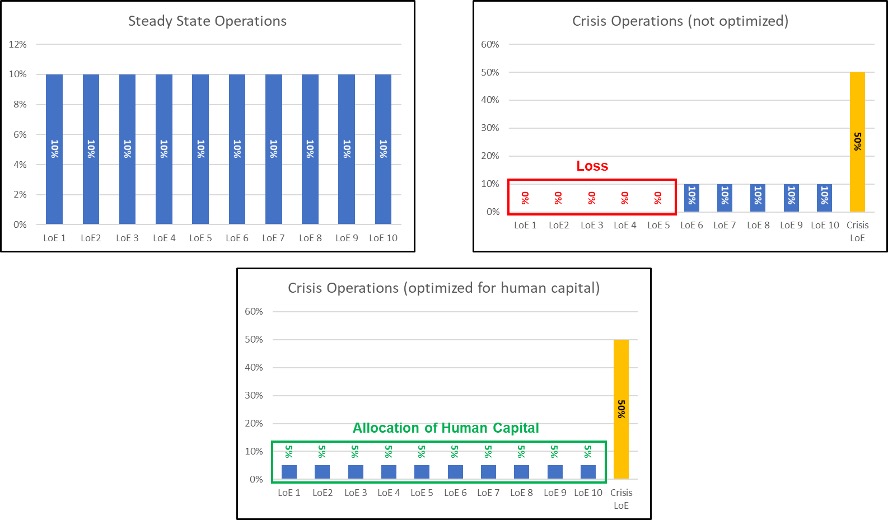
In a hypothetical scenario, an organization has ten lines of effort.  Each line of effort conveniently utilizes ten percent of the overall manpower.  Further, the program management office has rank ordered each of the groups by strategic importance from one to ten.  In the event of a disaster, senior management decides that they will re-purpose personnel from the bottom five lines of effort to their new crisis management response team.  While they will still reap the rewards of five of their original objectives and mitigate the crisis, they are absorbing an enormous opportunity cost by indefinitely forestalling the other five objectives.  An alternative and far more efficacious approach is to sub divide the workload of the degraded lines of effort among the team members of the remaining five groups.  Figure 1 captures the benefits of optimizing human capital:
maintaining-business-continuity-figure-1

Figure 1.

Although it seems untenable to suddenly modify the workload of a small portion of employees, properly assessing the available human capital will show that there are individuals who are up to the task.  To be clear, the untimely upheaval in company structure will still diminish business objectives, but having a dedicated team maintaining forward progress outside the scope of the crisis will ensure the continued delivery of value to the organization.  Notwithstanding, maintaining business continuity with severely constrained resources will require the innovative tools of focused process improvement.

Focused Process Improvement.  If rearrangement of the manpower inventory is the catalyst for achieving business continuity, then harnessing process improvement tools is the fuel that keeps the initiatives in motion.  Unfortunately, channeling resources to alleviate crisis magnifies the effects of the triple constraints on enduring efforts.  Inadequate resourcing, condensed timelines, and reduced scope all threaten to test the limits of the team, so innovative approaches are vital.  Leaders must empower their subordinates by deferring to their expertise and affording them the latitude to accomplish tasks via unconventional approaches.  With newfound influence, the team will be able to rapidly identify various inefficiencies and defects in the organization’s processes.  Often it takes extraordinary and challenging circumstances to identify issues that would never be addressed under the status quo.  Identifying problems is only half the battle though.  Failing to conduct analysis and provide a viable solution can simply exacerbate the issue.  Hence, focused process improvement is an invaluable asset that will help frame the problem and keep the team fixated on improvement.  An example of an all too common bureaucratic procedure will exemplify this.

Using the same theoretical company in the previous example, the business continuity team quickly realizes that there are significant procedural hurdles when moving projects through the project life cycle.  Mandatory phase gate meetings, progress reviews, and numerous stakeholder updates overburden the team’s capacity.  Furthermore, each of these engagements requires follow-up documentation that gets routed for signature approval through several departments.  The team decides to focus solely on this governance aspect of the lifecycle process and determines that they can reduce the number of touch points by 75 percent.  These measures alleviate the already constrained continuity team’s responsibilities and allow them to devote more of their time to advancing the timely completion of deliverables.

In unprecedented times, the amplification of constraints calls for both inventive allocation of talent and the application of process improvement to continue impacting the bottom line.  However, these tactics are not fruitful if the organization lacks the proper vision.

Strategic Emphasis.  The utility of creative solutions is meaningless if leaders do not support it.  Although the world has turned its attention exclusively towards the crisis, the onus is on management to keep delivering value while concurrently averting the fallout of the pandemic.  The shadow of disaster shrouds mundane operations from view, but a failure to sustain continuity will incur a hefty cost when normality returns.  The leaders who understand the criticality of these costs will divide their talent pool in a way that does not bring standard operations to a grinding halt.  They will vest their teams with the proper tools and message the strategic importance of bringing those tools to bear.  Ultimately, this top-level emphasis is a transparent way to show that leaders acknowledge the gravity of the current environment yet have the foresight to anticipate the future that lies ahead.

Although all eyes are now on the pandemic, there will come a time when they revert to steady state operations.  When that time comes, those who took the twofold approach towards maintaining business continuity and confronting COVID-19 will emerge in far greater standing.  Rather than spend months or even years picking up the pieces in the aftermath, the organizations that practiced resiliency and portrayed adaptability will be paragons for future success when the next catastrophe strikes.

5 Imperatives to Hiring a Lean Six Sigma Expert for Your Hospital

5 Imperatives to Hiring a Lean Six Sigma Expert for Your Hospital 150 150 Novaces | Lean Six Sigma Training | Process Improvement | Healthcare | Government | Defense
Submitted By: Brian MacClaren

Hiring an expert is often one of the first steps taken by hospitals embarking upon a Lean Healthcare or Lean Six Sigma program. Usually a Lean Six Sigma Black Belt is chosen to develop the program. Unfortunately, there are few Black Belts at large that actually have the Lean Six Sigma skills and healthcare experience necessary to build an effective, self-sustaining program.

Imperative #1- Know How to Evaluate Technical Proficiency

With the recent explosion of open enrollment training programs from local colleges and online providers, there is no shortage of candidates who claim Lean Six Sigma expertise on their resumes. For Lean Six Sigma, training is only a first step of the journey to become proficient in the multitude of tools that your organization can take advantage of. During an interview with a candidate, one imperative is to evaluate the mastery of technical skills.

First and foremost, we have learned that it is unwise to take a candidate’s depiction of technical skills on their resume at face value. These skills must be demonstrated during the interview because, in our experience, Lean Six Sigma certification does not prepare an individual to be an internal consultant for an organization such as yours. But how do you evaluate technical skills during a candidate interview? We recommend doing this in three ways:

1. Written exam
2. Oral exam
3. Platform instruction

Written Exam
Sound like a job for a professional certifying organization? Yes, but… the body of knowledge for Lean Six Sigma professionals varies so much across industries that only one organization can be relied upon for producing a certified Lean Six Sigma Black Belt. This organization is the American Society for Quality (ASQ) – and its Black Belt certification exam is one of the most rigorous in the industry. NOVACES bases all of its Lean Six Sigma courses on ASQ’s body of knowledge. If a resume does not say ASQ CSSBB (Certified Six Sigma Black Belt), then you must be prepared to administer an exam for each these candidates. Administer this exam before you spend time interviewing the candidate – without technical skills you must pass on the candidate completely.

We recommend an exam that includes a mixture of multiple choice questions related to Lean, Six Sigma, and even Theory of Constraints. The exam should be design with a minimum passing score of 80% and generally no less than 30 questions. If you need help designing such an exam, or would like to have your exam evaluated for content and correctness, please contact us and we will assist you. We also have collections of exam questions with healthcare context to share.

Oral Exam
This is a very effective element of the candidate evaluation process. Granted that the candidate has already passed the written exam, this gives the interviewer a chance to see how the individual might interact with people in your organization that require coaching or explanations of information during projects.

Importantly, this is done without giving the candidate any chance in advance to prepare. Do not be hesitant to do this. It is an exercise that puts their mastery of the skillset to the test. If the candidate needs six months to a year to grow into the job you are hiring them for, then a better alternative is to grow a trusted member of your team that already knows your organization’s culture and politics.

During the oral exam, ask questions that a Black Belt should be expected to be able to answer as if they have been doing this job professionally for several years. These are questions such as:

  • Identify which type of data is represented by several examples
  • Select the correct tool to apply for various scenarios
  • Calculate the number of defects per million opportunities (DPMO)
  • Walk through the steps to correctly perform a hypothesis test
  • Discuss the steps they take when facilitating an improvement workshop from pre-workshop preparation to post-workshop sustainment

The expectation, of course, is that the candidate can correctly answer all of these questions. Failing to do so leaves their technical skills suspect, because this type of knowledge should be automatic. However, what you also need to read into is the following:

  1. How confident was the candidate about the answer? Did they stumble? If so, how did they handle not knowing the answer immediately?
  2. Did they simply answer the question or did they walk you through why they answered the way they did? Were they more like a teacher or a student? You need the teacher.

This part of the interview usually benefits by having someone who is a trusted technical expert listen in and help with the evaluation. The oral evaluation really puts the candidate in the hot seat – which is exactly where you need them to be most effective when working at-large in your organization.

Platform Instruction
The final test to evaluate the technical Lean healthcare and Six Sigma skills for hospitals serves two purposes: (1) does the candidate know the material well enough that they can effectively teach others; and (2) how soon will you be able to internalize the training for your organization by relying on this individual to teach your physicians, nurses, technicians and other staff members?

This part of the interview benefits from preparation in advance by the candidate. Send a selection of two to three sets of slides about 2-3 days in advance of the interview. The selections of slides should consist of your organization’s Lean Six Sigma training materials, such as those that a consulting company used for training an initial group or from an open enrollment course that you may have sent people to for training. The selections should cover the following:

  • An introductory topic, such as “Introduction to Lean Six Sigma”
  • The application of several basic quality tools (fishbone diagram, visual management, metrics, voice of the customer, etc.)
  • The application of a more advanced statistical tool, or a topic that you believe is critical for your organization

During the interview, have the candidate teach the training material as if you were a member of the class. Ask questions (even a couple tough ones) to see how the candidate handles being “off the slide.” Pay careful attention to how information is explained. Is it taught from experience and example, or is the candidate reading the bullets? Has the candidate prepared and demonstrated how they can communicate from the platform. And importantly, can the candidate relate the topics to healthcare and to you?

Summary
Hiring a Lean Six Sigma expert for healthcare is an important task. This person will likely be your one-person army in making the program a success for the first year or two. These technical skills are a must-have for any candidate you will hire into your organization for this job. This individual will be responsible for good results on the first projects and for growing new talent within your organization. Take the steps outlined in this edition of “5 Imperatives to Hiring a Lean Six Sigma Expert for Your Hospital” and increase the chances of growing a productive and rewarding performance improvement program.

Keep watch for the next installment of this series to learn more about the 5 imperatives. You can also find more information about building a best-of-breed improvement program in our book, Performance Improvement in Healthcare.

Novaces | Lean Six Sigma Training | Process Improvement | Healthcare | Government | Defense