Healthcare

NOVACES is aboard the USS Theodore Roosevelt as it welcomes the Mentor, Train and Evaluate Team

NOVACES is aboard the USS Theodore Roosevelt as it welcomes the Mentor, Train and Evaluate Team 150 150 Novaces | Lean Six Sigma Training | Process Improvement | Healthcare | Government | Defense
Submitted By: Brian MacClaren

SAN DIEGO– The Mentor, Train and Evaluate (MTE) program, led by the Bureau of Medicine and Surgery (BUMED), brought their knowledge and capabilities to the West Coast for the first time, with a visit to the Nimitz-class aircraft carrier USS Theodore Roosevelt (CVN 71) from Aug.14-18, 2023.

The primary goal of MTE is to strengthen the readiness by optimizing and solidifying medical processes and procedures across the Navy Fleet. NOVACES provides Performance Improvement services to BUMED and its experts were deployed to support the MTE evolution. For more information about this event, please visit the full article at this link: med.navy.mil/Media

Maintaining Business Continuity in Crisis – COVID-19

Maintaining Business Continuity in Crisis – COVID-19 150 150 Novaces | Lean Six Sigma Training | Process Improvement | Healthcare | Government | Defense
Submitted By: Brian MacClaren

Author: Paul Dean, NOVACES (Washington, D.C.)

Amidst the uncertainty of the current environment, the currency of information expires within a few short weeks, sometimes merely within days.  Indeed, the global outlook in February 2020 is entirely alien in the context of what we now know two months later.  However volatile our predicament may seem though, two things are certain: the pandemic of COVID-19 will ultimately end, and another pandemic looms on the horizon.  While it is exceedingly difficult to consider returning to the status quo, it is imperative that leadership aligns business objectives with that inevitability in mind.  Whether the crisis subsides in six weeks or six months, the organizations that can maintain continuity in their operations will emerge leaps and bounds ahead of their peers when the dust settles.

A calamity of this scale is unprecedented in our lifetime, so it is of little wonder that organizations are channeling the entirety of their resources towards combating the issue.  In fact, the gravity of the situation almost necessitates this colossal response.  However, many institutions are failing to consider the trade-offs of this all-in approach.  The intent of this paper is to shed light on these concerns in the hope that leaders will evaluate the true opportunity costs at stake and calibrate a more measured response.  The ideal end state is to achieve impactful contributions at the current worldwide forefront while simultaneously accomplishing most business objectives that existed prior to the crisis.  There are numerous paths to attaining this end, but each response will require a certain measure of the following key tactics: reallocation of human capital, focused process improvement, and strategic emphasis.

Reallocation of Human Capital.  A catastrophic event has the potential to shake the foundation of an organization’s strategic vision, and talent management is typically the first casualty.  As Von Molke’s timeless insight goes, “no plan survives first contact”, and leaders’ first impulse in dire circumstances is to forgo previously assigned roles and responsibilities.  In doing so, they immediately redirect most of their assets to address the issue at hand.  Although this may be the best tactic for weathering the adverse effects of the predicament, it will not age well.  If management dedicates an overabundance of human capital to the principal problem, they will neglect to realize the gains from their routine business operations.  A rudimentary example will illustrate this further.

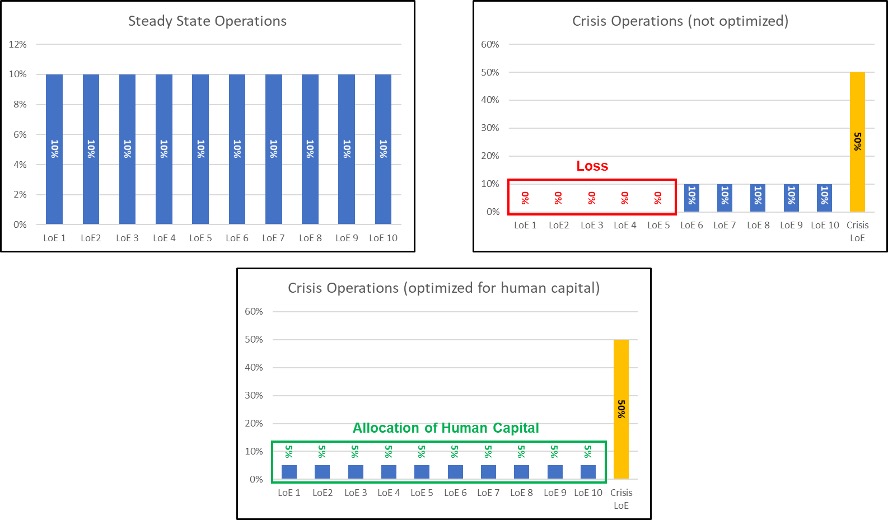
In a hypothetical scenario, an organization has ten lines of effort.  Each line of effort conveniently utilizes ten percent of the overall manpower.  Further, the program management office has rank ordered each of the groups by strategic importance from one to ten.  In the event of a disaster, senior management decides that they will re-purpose personnel from the bottom five lines of effort to their new crisis management response team.  While they will still reap the rewards of five of their original objectives and mitigate the crisis, they are absorbing an enormous opportunity cost by indefinitely forestalling the other five objectives.  An alternative and far more efficacious approach is to sub divide the workload of the degraded lines of effort among the team members of the remaining five groups.  Figure 1 captures the benefits of optimizing human capital:

maintaining-business-continuity-figure-1

Figure 1.

Although it seems untenable to suddenly modify the workload of a small portion of employees, properly assessing the available human capital will show that there are individuals who are up to the task.  To be clear, the untimely upheaval in company structure will still diminish business objectives, but having a dedicated team maintaining forward progress outside the scope of the crisis will ensure the continued delivery of value to the organization.  Notwithstanding, maintaining business continuity with severely constrained resources will require the innovative tools of focused process improvement.

Focused Process Improvement.  If rearrangement of the manpower inventory is the catalyst for achieving business continuity, then harnessing process improvement tools is the fuel that keeps the initiatives in motion.  Unfortunately, channeling resources to alleviate crisis magnifies the effects of the triple constraints on enduring efforts.  Inadequate resourcing, condensed timelines, and reduced scope all threaten to test the limits of the team, so innovative approaches are vital.  Leaders must empower their subordinates by deferring to their expertise and affording them the latitude to accomplish tasks via unconventional approaches.  With newfound influence, the team will be able to rapidly identify various inefficiencies and defects in the organization’s processes.  Often it takes extraordinary and challenging circumstances to identify issues that would never be addressed under the status quo.  Identifying problems is only half the battle though.  Failing to conduct analysis and provide a viable solution can simply exacerbate the issue.  Hence, focused process improvement is an invaluable asset that will help frame the problem and keep the team fixated on improvement.  An example of an all too common bureaucratic procedure will exemplify this.

Using the same theoretical company in the previous example, the business continuity team quickly realizes that there are significant procedural hurdles when moving projects through the project life cycle.  Mandatory phase gate meetings, progress reviews, and numerous stakeholder updates overburden the team’s capacity.  Furthermore, each of these engagements requires follow-up documentation that gets routed for signature approval through several departments.  The team decides to focus solely on this governance aspect of the lifecycle process and determines that they can reduce the number of touch points by 75 percent.  These measures alleviate the already constrained continuity team’s responsibilities and allow them to devote more of their time to advancing the timely completion of deliverables.

In unprecedented times, the amplification of constraints calls for both inventive allocation of talent and the application of process improvement to continue impacting the bottom line.  However, these tactics are not fruitful if the organization lacks the proper vision.

Strategic Emphasis.  The utility of creative solutions is meaningless if leaders do not support it.  Although the world has turned its attention exclusively towards the crisis, the onus is on management to keep delivering value while concurrently averting the fallout of the pandemic.  The shadow of disaster shrouds mundane operations from view, but a failure to sustain continuity will incur a hefty cost when normality returns.  The leaders who understand the criticality of these costs will divide their talent pool in a way that does not bring standard operations to a grinding halt.  They will vest their teams with the proper tools and message the strategic importance of bringing those tools to bear.  Ultimately, this top-level emphasis is a transparent way to show that leaders acknowledge the gravity of the current environment yet have the foresight to anticipate the future that lies ahead.

Although all eyes are now on the pandemic, there will come a time when they revert to steady state operations.  When that time comes, those who took the twofold approach towards maintaining business continuity and confronting COVID-19 will emerge in far greater standing.  Rather than spend months or even years picking up the pieces in the aftermath, the organizations that practiced resiliency and portrayed adaptability will be paragons for future success when the next catastrophe strikes.

Catching the HRO Wave: Marching Towards “Zero Harm to Patients”

Catching the HRO Wave: Marching Towards “Zero Harm to Patients” 150 150 Novaces | Lean Six Sigma Training | Process Improvement | Healthcare | Government | Defense
Submitted By: Dr. Bahadir Inozu

After seeing the benefits of becoming a High Reliability Organization (HRO) in other industries, Military Healthcare System (MHS) is transforming into an HRO, as mandated following a  Secretary of Defense ordered review of safety, access, and quality in 2014.  This review stated that, “The foundation for improving performance in the MHS rests on combining the concepts of an integrated health care system with those of high reliability organizations. The principles of a high reliability organization are operationalized through leadership engagement, a culture of quality and safety, robust process improvement,” according to the review.

HROs are able to reduce errors through culture changes and technology while working in an inherently high-stress, high-tempo environment. In collaboration with George Mason University, NOVACES sponsored a one-day workshop on “Developing a Culture of Safety in Health Care: The Benefits of Becoming a High Reliability Organization” on June 24, 2015 in Fairfax, Virginia to raise awareness about the benefits of HRO to encourage other Healthcare Systems to become HRO’s.

The workshop started with a focus on “Why Change?” and it provided a basis for understanding how adopting HRO operational practices can help create a culture of safety, reduce the number of errors, and meet safety, quality, and efficiency goals.

Why should hospitals become High Reliability Organizations?

It is estimated that as many as as many as 400,000 preventable deaths occur every year in the United States in civilian hospitals, according to an article published in the Journal of Patient Safety in 2013. Indeed, almost everyone knows at least one person who was harmed due to preventable mistakes at hospitals. Hence, there appears to be a consensus to increase the patient safety levels to new heights.

The Goal of becoming an HRO is “zero preventable harm in high risk operations.” Other high risk industries have achieved this goal to a certain extent such as the Aerospace, Civil Aviation, Nuclear Power Industries as well as Nuclear Submarines and Aircraft Carriers. Transformation to HROs is long overdue for the healthcare industry.

“If done properly, the quality of care will markedly improve throughout the transformation process. HRO is not just another initiative, it’s a commitment to your patients that’s too important not to make,” said Spence Byrum, CEO of HRS Consulting, Inc. He saw its amazing impact in aviation, as a former United States Coast Guard pilot.  There is a pending rule that will further reduce reimbursement for hospitals not proficient in an “all hazards” approach to disaster preparedness. “Reimbursements will go down if hospitals do not take an all hazards approach,” Byrum warned.

“You have a plan. Then life will let you know whether your plan is any good!” said W. Earl Carnes, who served as a Senior Advisor of DOE for High Reliability & Liaison with the Institute of Nuclear Power Operations (INPO).  He added “It is hard to see what HRO’s do. Most organizations focus on tools, but attempts to adopt practices without understanding concepts, models and principles routinely meet with failure. What is missing is how they think, how they work together, what they view as important. Perhaps the best way to learn is to listen to their stories, to hear about both what they do and how they think.”

“People who understand this approach best are those who have been vulnerable… People who have been at risk of dying” said Dr. Daved van Stralen, who pioneered the application of HRO principles in healthcare. He added, “There is a cross over, a threshold that changes the way they think. It is hard to translate that to other people.”

“Your life is a lot safer because of HROs” said Mark A. Crafton, Executive Director of State and External Relations at The Joint Commission. He gave examples from other his risk industries including aviation, banking and theme parks. Universal Studios in Orlando is a good benchmark, where the goal is to ensure safety of staff and visitors. Entire park and each stunt are under constant video surveillance and safety personnel intervene immediately when a safety risk is detected.

Some of the leading hospitals already started their journey to HRO transformation include Atlantic Health, Barnes-Jewish, Baylor, Cedars-Sinai, Cleveland Clinic, Exempla, Fairview, Floyd Medical Center, Froedtert, Intermountain, Johns Hopkins, Kaiser-Permanente, Mayo Clinic, Memorial Hermann, New York-Presbyterian, North Shore-LIJ, Northwestern, OSF, Partners HealthCare, Sharp Healthcare, Stanford Hospital, Texas Health Resources, Trinity Health, VA Healthcare System-CT, Virtua, Wake Forest Baptist, Wentworth-Douglass and MedStar Health. And the list is growing fast with the addition of the Military Health System.

The workshop participants also discussed “What blocks us from reaching the HRO goal? What are the constraints and how to break them? Which information will we need?” In the next article we will discuss these and “What to Change” to become an HRO.

Update #2 on Emergency Department “Door to Doc” Time

Update #2 on Emergency Department “Door to Doc” Time 150 150 Novaces | Lean Six Sigma Training | Process Improvement | Healthcare | Government | Defense

Submitted By: Bob Sproull

The Emergency Department improvement team began developing their current state process map and found out very early on that imagining their process and getting it down on paper was not an easy task.  There were disagreements for sure on how the actual process looks, but the most difficult thing was deciding how to map out the five different scenarios that existed within their ED as follows:

Scenario 1:  Patient enters the ED and is moved directly to an ED bed.

Scenario 2:  Patient is triaged (Triage 1), moves to the patient waiting room, patient is triaged (Triage 2), and finally is moved to an ED bed.

Scenario 3:  Patient is triaged (Triage 1), then immediately triaged again (Triage 2), then moves to a waiting room and then is moved to an ED bed.

Scenario 4:  Patient is triaged (Triage 1), then moves to the waiting room, then is triaged again (Triage 2), then moves back to the waiting room, then finally is moved to an ED bed.

Scenario 5:  Patient is triaged (Triage 1), then immediately to Triage 2, then immediately to the ED bed.

The team was struggling on how best to map these individual processes and could not see an easy way to do so.  I asked them a series of questions as follows:

  1. Which scenario is the fastest?  They assured me that Scenario 1 was much faster than any of the others.
  2. Which scenario is the slowest?  They told me that Scenario 4 was by far and away the slowest.
  3. Which scenario is most commonly used for patients and they told me that Scenario 4 was used for about 80% of the patients.

The team asked me what they should do and I simply told them that since Scenario 4 applied to 80 % of the patients that they should focus their efforts on that one since it represents the largest opportunity to improve both the cycle time and patient satisfaction metrics.  This was a classic case of the infamous Pareto Principle meaning that 80% of their improvement will come from 20% of their scenarios (i.e. 1 of 5 scenarios).

I also explained that they should also review what things aren’t done in Scenario 1 that make it much faster than any of the others.  This could in fact become their Ideal State and help them create a future state that meets all of their performance objectives.

The team has completed their first draft of the current state process map and will complete it tomorrow.  They will also be completing their value stream analysis by categorizing each step as value-added (color-coded as Green), non-value-added (color-coded as Red) and non-value-added but necessary (color-coded as Yellow).  When this is completed the team will then create their ideal and future state maps.

One problem the team rightfully pointed out was that it is relatively easy to “speed-up” the front end of the process by reducing the time it takes to get the patient to the ED Exam Room, but getting the doctor to the exam sooner is going to be difficult.  We then created an Interference Diagram (ID) to better understand what gets in the way of reducing the time it takes for the doctor to see the patient.  Figure 1 is the ID the team created.

Figure 1

The team then began looking for potential solutions for each of the interferences listed in the ID which I will report on in my next posting.

Bob Sproull

Healthcare Performance Improvement: Yesterday, Today, and Tomorrow (Part 2)

Healthcare Performance Improvement: Yesterday, Today, and Tomorrow (Part 2) 150 150 Novaces | Lean Six Sigma Training | Process Improvement | Healthcare | Government | Defense

Submitted By: Dan Chauncey

Today

Many put the start of the quality revolution with the NBC Television’s show “NBC White Paper.” On June 24, 1980 Lloyd Dobbins introduced W. Edwards Deming to America in an episode entitled: If Japan can… Why can’t we?

The show addressed how Deming’s advice on continuous process improvement and recognizing that manufacturing is a system, not simply separate assembly steps. While the application of what came to be called TQM was applied sporadically within healthcare, the use of PDCA seemed to take hold and became widespread in its use. Not only did it align nicely with the scientific method widely understood in healthcare, but gained momentum when it was modified with the addition of the set of preliminary steps: FOCUS, by Hospital Corporation of America (currently the largest private operator of health care facilities in the world). It is not known whether the expansion of its use was based on efficacy or the notoriety of its developer.

While many quality theories or approaches were short-lived, three seemed to take hold—albeit independent of each other. Starting in manufacturing, these three methods have survived to improve quality and efficiency: Lean, Six Sigma, and Constraints Management. Throughout the 1990s, these methodologies began to be applied in other industries. Despite successes wherever applied, certain industries have been slower to accept certain quality tools and methods from manufacturing despite more than 30 years of successful application. It is critical to note that the finding is about acceptance, not applicability; for example, while control charts have been used extensively in manufacturing since the 1920s and have been used successfully in healthcare, their usage is not as widespread as one would expect.

Lean in Healthcare

Lean focuses on eliminating waste. Most literature lists seven different types of waste (shown below). While these were developed originally for applicability within manufacturing, they are equally relevant in healthcare.

Transport. Any time people, materials, or information must be moved, it is defined as waste. Moving patients from room to room is an example of waste. While in many cases necessary, this transportation nonetheless is viewed as waste. Use of a spaghetti diagram may help to minimize this type of waste.

Inventory. While it is necessary to maintain inventories to ensure availability, anything short of just-in-time (JIT) availability is categorized as waste. Tools such as kanban can mitigate this kind of waste.

Motion. A nurse’s station with a desktop computer at one end and a printer at the other that requires nurses to move excessively to pick up printouts is an example of waste. Good ergonomic practices and more efficient workspace layouts can moderate this waste.

Waiting. This waste is endemic to healthcare. We even call our primary customers patients—is this because it is an expectation? Elimination of non-value-adding activities can diminish this waste.

Overproduction. Running too many tests and printing too many copies of paperwork are examples of overproduction. Reviewing standard lab panels or pursuing paperless processes can mitigate this type of waste.

Overprocessing. Requiring excess approvals and running the same test twice are examples of overprocessing. The elimination of non-value adding activities can lessen this sort of waste dramatically.

Defects. When a product or service does not meet specification or customer expectations, it is a defect. Defects often result in rework, and the associated costs frequently go unaccounted for.

Six Sigma in Healthcare

The power of Six Sigma is its ability to identify root causes of complex problems and reduce variation, both of which are central to the improvement of processes. Examples of Six Sigma applications in healthcare include reduction of infection rates, patient falls, and missed appointments, as well as enhanced medication reconciliations and coding. Anywhere the root cause is not known. While historically, the concept of root cause analysis in healthcare process improvement has relied largely on softer tools such as Failure Modes and Effects Analysis and Fishbone Diagrams; Six Sigma relies on the use of inferential statistics to validate root causes.

Constraints Management in Healthcare

Constraints Management is a management philosophy encompassing an integrated suite of techniques used in operations and supply-chain management, project management, conflict resolution, and   strategic planning. Dr. Eliyahu Goldratt began its development in 1979 with the production scheduling software OPT, and has led its evolution into three interrelated areas—logistics/production, performance measurement, and problem-solving/thinking tools.

It is a systematic approach to managing complex organizations by identifying and controlling key leverage points within a system or process. By managing these key control points, healthcare organizations can focus on areas that drive system-level improvement instead of trying to manage every element of a process, which can lead to local optimization without systemic impact.

A constraint is anything that limits the system from achieving higher performance relative to its goal. In healthcare, a constraint is anything that impedes the ability or means to provide or deliver care. Common types of constraints include:

  • Market
  • Resource
  • Material
  • Supplier/vendor
  • Financial
  • Knowledge/competence
  • Policy

Once the constraint is identified, numerous tools are available to mitigate it. Within healthcare, Constraints Management was pioneered at the University of Pretoria Medical School in 1991. One of the earliest reported applications of Constraints Management in U.S. healthcare was at the University of Michigan Hospital. The hospital’s admission and discharge system was inefficient, resulting in an average of three hours’ delay in accepting incoming patients, who waited for their rooms to be prepared. Constraints Management allowed the hospital to reduce the average time to admit patients from 3 hours to just 11 minutes.

Transition to an Integrated Approach

Each of these methodologies has stood the test of time; each has been around as a distinct entity for more than 30 years. The problem is that most people tend to be in one camp or another. After years or practice and much research, we (NOVACES) have come to the—not so shocking—conclusion that one should apply the right tool to the right problem at the right time.

If you are looking for focus: you might look in the Constraints Management section of your toolbox, root cause analysis: Six Sigma section; improving flow: the Lean section. Maybe even sometimes, you might have to pull something from a couple of sections to solve the same issue!

Healthcare Performance Improvement: Yesterday, Today, and Tomorrow (Part 1)

Healthcare Performance Improvement: Yesterday, Today, and Tomorrow (Part 1) 150 150 Novaces | Lean Six Sigma Training | Process Improvement | Healthcare | Government | Defense
Submitted By: Dan Chauncey

Yesterday

How does an integrated approach to performance improvement in healthcare differ from historical quality improvement? First let’s do a quick look back at quality improvement. Within healthcare we could go all the way back to Hippocrates, but let’s stay a little more contemporary. Most people like to start with Dr. Ignaz Semmelweis or Florence Nightingale.

In 1847, Dr. Semmelweis studied the transmittal of puerperal fever, an infection occurring in post-partum females. Dr. Semmelweis was able to document that physicians and medical students would perform autopsies, and in the same clothing (dirty aprons and all), frequently, merely wiping their bloody hands on their aprons, and then perform gynecologic examinations on the new mothers. By instituting hand washing with chloride of lime prior to examining the females, the infection rate dropped over 80%.

During the Crimean War (1853-1857), Florence Nightingale recorded that in the first seven months of the campaign, 60 percent of the soldiers died from infections. She and her team focused on improving cleanliness, sanitation, nutrition, administrative order, and patient care. In the following three years, Nightingale and her team drastically improved the conditions for the care of soldiers, reducing the death rate among patients.

In my experience, I have found that the historical underpinnings of quality improvement in healthcare were largely reactive in nature. Semmelweis’ recognition of the disparity in puerperal fever between two seemingly similar hospitals, or Florence Nightingale’s refusal to accept the non-combat death rates during the Crimean War.

Another venue where healthcare quality was impacted is through academic research. Examples include Avedis Donabedian, who collated the growing literature of health services research as it appeared through the 1950s and early 1960s and presented his findings in a lengthy paper in 1966 with the title “Evaluating the Quality of Medical Care”. In it he sets out the necessity of examining the quality of health provision in the aspects of structure, process and outcome. Another example of quality research is the volume-outcomes relationship initially described by Luft et al in 1979.

As healthcare moved into a more localized application of quality improvement, many organizations began applying the PDCA model. Although plan-do-check-act (PDCA) was developed originally by the father of statistical quality control, Walter A. Shewhart, W. Edwards Deming, who was his student, later went on to develop Total Quality Management (TQM) and became a founding father of management science in his own right. Deming’s application of PDCA (and PDSA) called for managers to hypothesize, develop, and plan improvements; implement and do the improvements, almost as if performing a scientific experiment; checking, studying, and evaluating the outcomes and results; and then acting based on considered analysis to instill the change on a continued basis until it could be improved further. In so doing, Deming applied the principles of scientific management to the aim of perpetually improving organizations.

Shortly it became apparent that PDCA was more of an implementation approach that began with a hypothesized solution. In the 1980s the Hospital Corporation of America added yet another acronym to the vernacular—find-organize-clarify-understand-select (FOCUS). In the FOCUS-PDCA paradigm, preceding PDCA, FOCUS calls for finding an improvement opportunity, organizing an improvement team, clarifying the current state of the process, understanding the causes for variation in the process, and selecting the improvement. This was the first complete methodological approach to improving quality that ranged from problem identification to implementation of the solution.

Many hospitals still apply FOCUS-PDCA supplemented, in some instances, with an industrial engineering approach to quality improvement. This outside-in—using industrial engineers—approach allows only a minimal involvement of clinical staff. The staff members, who do the work, know the process, deal with the problems, and need to be a part of the solution. While this is evident, some model still exclude them.

A quality revolution began in the 1980’s. It began in manufacturing, transitioned to transactional industries in the 1990’s, and by the turn of the century was slowly making inroads into healthcare.

NOVACES will be making a Special Breakfast Presentation at the 24th IHI

NOVACES will be making a Special Breakfast Presentation at the 24th IHI 150 150 Novaces | Lean Six Sigma Training | Process Improvement | Healthcare | Government | Defense
Submitted By: Brian MacClaren

NOVACES will be making a Special Breakfast Presentation at the 24th IHI – Annual National Forum on Quality Improvement in Health Care

SIB1: “Force Multiplier: Using Constraints Management to Take Operational Excellence to Dramatic New Levels” by Halder, Robert, MD, Rear Admiral, US Navy (Ret), Executive Medical Consultant, NOVACES, LLC; Makaroff, Jason, Senior Business Consultant, NOVACES, LCC; Ross, T., RN, Lean Six Sigma Program Coordinator, St. Alexius Medical Center

Wednesday, December 12 • 7:00 AM – 7:45 AM
Orlando World Center Marriott Resort & Convention Center

http://www.ihi.org/offerings/Conferences/Forum2012/Pages/default.aspx

How a Value Stream Analysis Can Help You Elminate Non-Value Adding Activities

How a Value Stream Analysis Can Help You Elminate Non-Value Adding Activities 150 150 Novaces | Lean Six Sigma Training | Process Improvement | Healthcare | Government | Defense

How a Value Stream Analysis Can Help You Elminate Non-Value Adding Activities

Submitted By: Dr. Bahadir Inozu
Categories: Healthcare

Below is an excerpt from Chapter 6 of our recently published book, Performance Improvement for Healthcare: Leading Change with Lean, Six Sigma, and Constraints Management

A Process-level VSA, or ProcessVSA, is an approach to analyzing a process to identify and eliminate non-value adding activities as well as to develop procedures to manage bottlenecks effectively and break these bottlenecks when needed. For lean six sigma in healthcare, it is also a planning tool that uses process mapping to help understand how material and information flow through a process, as well as to identify constraints at the process level. Additionally, ideal and future state process maps are developed that focus future improvement activities within that process. ProcessVSAs are conducted by following a product’s or service’s path from suppliers to customers. Once the current state of the process is mapped, it is then analyzed to identify waste, inefficiencies, constraints, and other improvement opportunities. After areas of opportunity have been identified, an ideal state map is created to serve as a benchmark. Then a future state map is created showing how the material and information should flow and how the process bottleneck should be managed, if there is one. Champions are designated to sponsor improvement efforts by first determining the best approach. Finally, an action plan is prepared to move from the current state to the future state of the process. This action plan should include recommendations for future rapid improvement events, quick hits, and DMAIC and Constraints Management projects.

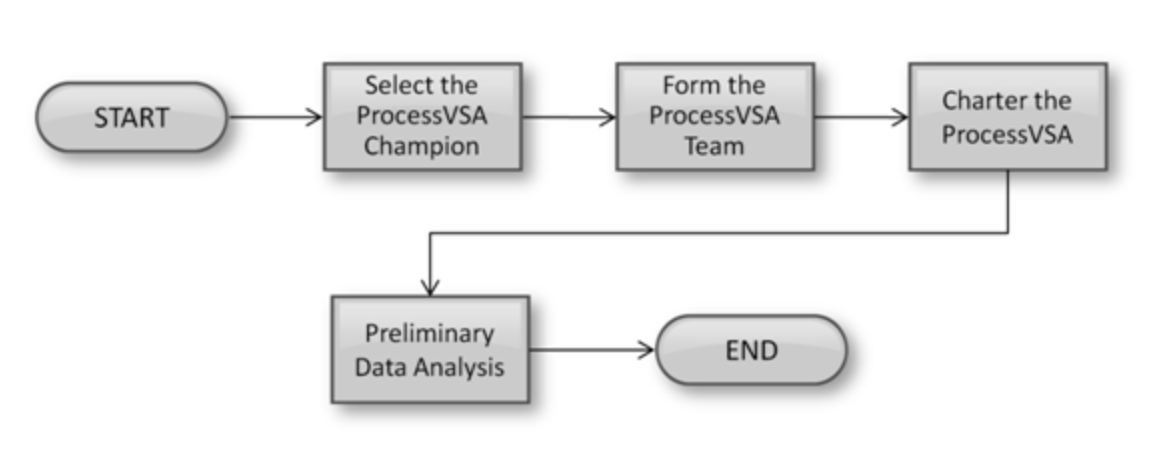
A ProcessVSA generally is run as a single event lasting five days or less. There are three phases to this process: pre-event, event and post-event. Each phase has a series of sequential steps to complete for a successful outcome. Figure 6.2 shows the ProcessVSA pre-event roadmap.

Figure 6.2 ProcessVSA pre-event roadmap

Click here for a free download of Chapter 1 of our book, Performance Improvement for Healthcare: Leading Change with Lean, Six Sigma, and Constraints Management.

Veterans Health Administration Steadily Increasing Use of Lean Six Sigma Process Improvement to Support Its Systems Redesign Initiative

Veterans Health Administration Steadily Increasing Use of Lean Six Sigma Process Improvement to Support Its Systems Redesign Initiative 150 150 Novaces | Lean Six Sigma Training | Process Improvement | Healthcare | Government | Defense
Submitted By: Brian MacClaren

Troop drawdowns in Iraq and Afghanistan and impending cuts in number of troops directed by the DoD has created an urgent need for business transformation within the VA hospital system that supports our veterans after they have transitioned back to civilian life.  Among the various improvement strategies for the VHA is the Systems Redesign, which aims to improve healthcare quality and access to care for veterans.

Systems Redesign leadership in the VHA has been using the process improvement methodology called Lean Six Sigma, which in the last decade has become a key management strategy and driver of change for civilian hospitals, to provide fundamental quality and process improvement tools to the teams who are leading transformation efforts within the VA Medical Centers.

Fargo VA Medical Center could be considered one of the more advanced VA medical centers in terms of adoption of Lean Six Sigma. The organization held a workshop in 2012 on how to manage improvement initiatives, which included an overview of the Lean Six Sigma methodology. Since then, the adoption of Lean Six Sigma has been steadily growing within the organization.

To develop the program from its early stages, leaders of Fargo VA Medical Center Systems Redesign contracted with NOVACES, a management consulting firm that specializes in performance improvement for veteran healthcare, for guidance on how to incorporate the VA High Performance Development Model and Veterans Health Administration System Redesign objectives.

“The right blend of Systems Redesign, TAMMCS, Lean Six Sigma and PDSA in a collaborative setting creates an environment for VA medical centers, like the one being experienced in Fargo, that promotes the kind of improvements needed to continue providing our nation’s veterans with the very highest quality healthcare services,” said retired U.S. Navy Captain Charles Mount, director of government healthcare services at NOVACES.


Other VA healthcare facilities, including VISN 8 Bay Pines VA Medical Center and North Chicago VA James A. Lovell Federal Health Care Center (FHCC) are also rigorously investing in Lean Six Sigma by training staff and leadership and completing improvement projects that are aligned with strategic plans.

Similar to the widespread adoption of Lean Six Sigma in civilian healthcare, healthcare performance improvement experts promote the rigor and analytical capabilities of this healthcare process improvement methodology to also drive the tremendous amount of change that the currently strained VHA healthcare system must undergo to meet the demand for care generated by the nation’s 22 million veterans.

5 Imperatives to Hiring a Lean Six Sigma Expert for Your Hospital

5 Imperatives to Hiring a Lean Six Sigma Expert for Your Hospital 150 150 Novaces | Lean Six Sigma Training | Process Improvement | Healthcare | Government | Defense
Submitted By: Brian MacClaren

Hiring an expert is often one of the first steps taken by hospitals embarking upon a Lean Healthcare or Lean Six Sigma program. Usually a Lean Six Sigma Black Belt is chosen to develop the program. Unfortunately, there are few Black Belts at large that actually have the Lean Six Sigma skills and healthcare experience necessary to build an effective, self-sustaining program.

Imperative #1- Know How to Evaluate Technical Proficiency

With the recent explosion of open enrollment training programs from local colleges and online providers, there is no shortage of candidates who claim Lean Six Sigma expertise on their resumes. For Lean Six Sigma, training is only a first step of the journey to become proficient in the multitude of tools that your organization can take advantage of. During an interview with a candidate, one imperative is to evaluate the mastery of technical skills.

First and foremost, we have learned that it is unwise to take a candidate’s depiction of technical skills on their resume at face value. These skills must be demonstrated during the interview because, in our experience, Lean Six Sigma certification does not prepare an individual to be an internal consultant for an organization such as yours. But how do you evaluate technical skills during a candidate interview? We recommend doing this in three ways:

1. Written exam
2. Oral exam
3. Platform instruction

Written Exam
Sound like a job for a professional certifying organization? Yes, but… the body of knowledge for Lean Six Sigma professionals varies so much across industries that only one organization can be relied upon for producing a certified Lean Six Sigma Black Belt. This organization is the American Society for Quality (ASQ) – and its Black Belt certification exam is one of the most rigorous in the industry. NOVACES bases all of its Lean Six Sigma courses on ASQ’s body of knowledge. If a resume does not say ASQ CSSBB (Certified Six Sigma Black Belt), then you must be prepared to administer an exam for each these candidates. Administer this exam before you spend time interviewing the candidate – without technical skills you must pass on the candidate completely.

We recommend an exam that includes a mixture of multiple choice questions related to Lean, Six Sigma, and even Theory of Constraints. The exam should be design with a minimum passing score of 80% and generally no less than 30 questions. If you need help designing such an exam, or would like to have your exam evaluated for content and correctness, please contact us and we will assist you. We also have collections of exam questions with healthcare context to share.

Oral Exam
This is a very effective element of the candidate evaluation process. Granted that the candidate has already passed the written exam, this gives the interviewer a chance to see how the individual might interact with people in your organization that require coaching or explanations of information during projects.

Importantly, this is done without giving the candidate any chance in advance to prepare. Do not be hesitant to do this. It is an exercise that puts their mastery of the skillset to the test. If the candidate needs six months to a year to grow into the job you are hiring them for, then a better alternative is to grow a trusted member of your team that already knows your organization’s culture and politics.

During the oral exam, ask questions that a Black Belt should be expected to be able to answer as if they have been doing this job professionally for several years. These are questions such as:

  • Identify which type of data is represented by several examples
  • Select the correct tool to apply for various scenarios
  • Calculate the number of defects per million opportunities (DPMO)
  • Walk through the steps to correctly perform a hypothesis test
  • Discuss the steps they take when facilitating an improvement workshop from pre-workshop preparation to post-workshop sustainment

The expectation, of course, is that the candidate can correctly answer all of these questions. Failing to do so leaves their technical skills suspect, because this type of knowledge should be automatic. However, what you also need to read into is the following:

  1. How confident was the candidate about the answer? Did they stumble? If so, how did they handle not knowing the answer immediately?
  2. Did they simply answer the question or did they walk you through why they answered the way they did? Were they more like a teacher or a student? You need the teacher.

This part of the interview usually benefits by having someone who is a trusted technical expert listen in and help with the evaluation. The oral evaluation really puts the candidate in the hot seat – which is exactly where you need them to be most effective when working at-large in your organization.

Platform Instruction
The final test to evaluate the technical Lean healthcare and Six Sigma skills for hospitals serves two purposes: (1) does the candidate know the material well enough that they can effectively teach others; and (2) how soon will you be able to internalize the training for your organization by relying on this individual to teach your physicians, nurses, technicians and other staff members?

This part of the interview benefits from preparation in advance by the candidate. Send a selection of two to three sets of slides about 2-3 days in advance of the interview. The selections of slides should consist of your organization’s Lean Six Sigma training materials, such as those that a consulting company used for training an initial group or from an open enrollment course that you may have sent people to for training. The selections should cover the following:

  • An introductory topic, such as “Introduction to Lean Six Sigma”
  • The application of several basic quality tools (fishbone diagram, visual management, metrics, voice of the customer, etc.)
  • The application of a more advanced statistical tool, or a topic that you believe is critical for your organization

During the interview, have the candidate teach the training material as if you were a member of the class. Ask questions (even a couple tough ones) to see how the candidate handles being “off the slide.” Pay careful attention to how information is explained. Is it taught from experience and example, or is the candidate reading the bullets? Has the candidate prepared and demonstrated how they can communicate from the platform. And importantly, can the candidate relate the topics to healthcare and to you?

Summary
Hiring a Lean Six Sigma expert for healthcare is an important task. This person will likely be your one-person army in making the program a success for the first year or two. These technical skills are a must-have for any candidate you will hire into your organization for this job. This individual will be responsible for good results on the first projects and for growing new talent within your organization. Take the steps outlined in this edition of “5 Imperatives to Hiring a Lean Six Sigma Expert for Your Hospital” and increase the chances of growing a productive and rewarding performance improvement program.

Keep watch for the next installment of this series to learn more about the 5 imperatives. You can also find more information about building a best-of-breed improvement program in our book, Performance Improvement in Healthcare.

Novaces | Lean Six Sigma Training | Process Improvement | Healthcare | Government | Defense